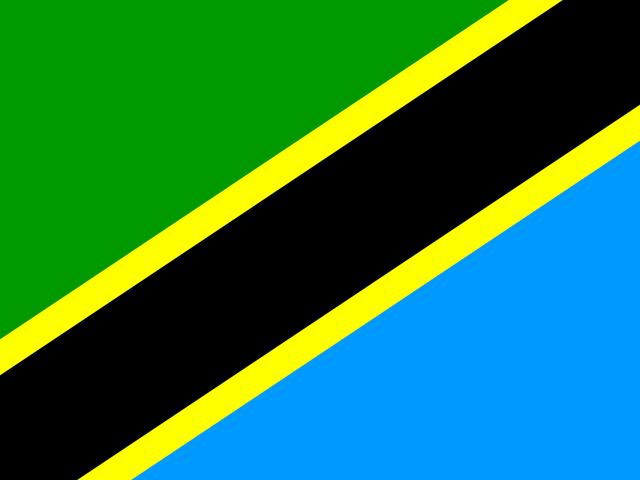
What the flag looks like
The Tanzanian flag is divided diagonally by a black band extending from the lower hoist corner to the upper fly corner. The band is edged in yellow. The upper triangle is green and the lower triangle is blue. The proportion is 2:3. It was adopted on 30 June 1964, when Tanganyika and Zanzibar merged to form the United Republic of Tanzania.
Colors and meaning
Green represents the vegetation and agriculture of mainland Tanzania, blue represents the Indian Ocean and Tanzania's lakes and rivers, black represents the African people of Tanzania, and the yellow edges represent Tanzania's mineral wealth, particularly gold.
Green
Represents the vegetation and agricultural wealth of mainland Tanzania, which has some of the most fertile land in East Africa.
Blue
Represents the Indian Ocean that borders Tanzania to the east, and the country's lakes — Lake Victoria, Lake Tanganyika and Lake Malawi — which are shared with neighboring countries.
Black
Represents the African people of Tanzania and their unity. The black band splitting the flag symbolizes the country's diverse population coming together.
Yellow edges
Represent Tanzania's mineral wealth, particularly gold, diamonds and tanzanite — a rare gemstone found only in Tanzania.
Union symbolism
The design combines the flags of Tanganyika (green with black and yellow stripes) and Zanzibar (blue, black and green horizontal stripes) into a single unified design, symbolizing the union of the two countries in 1964.
History and adoption
Tanzania was formed on 26 April 1964, when Tanganyika (independent since 1961) and Zanzibar (independent since 1963) merged. The flag was designed by combining elements from the two countries' flags — Tanganyika's green with black and yellow stripes, and Zanzibar's blue with black and green stripes — into a unified design. It was adopted on 30 June 1964 and has remained unchanged since, including during the socialist period under President Julius Nyerere. The flag is celebrated every 9 December as Tanzanian Independence Day.
Key facts
- Adopted
- 30 June 1964
- Proportion
- 2:3
- Designer
- Combined design based on the flags of Tanganyika and Zanzibar
- Capital
- Dodoma
- Country code
- TZ
- Similar flags
- None
Historical and related flags
Tanzania has used several flags across its colonial, independence and union periods.
- German East Africa (1885–1919): German colonial flags.
- British Tanganyika (1919–1961): British Blue Ensign with a colonial badge.
- Tanganyika (1961–1964): Green flag with black and yellow stripes.
- Sultanate of Zanzibar (1963–1964): Red flag with the sultan's emblem.
- People's Republic of Zanzibar (1964): Blue, black and green horizontal stripes.
- Current flag (1964–present): Green, black, yellow and blue diagonal design.
Frequently asked questions
What does the flag of Tanzania look like?
The flag of Tanzania is divided diagonally by a black band with thin yellow edges. The upper hoist triangle is green and the lower fly triangle is blue. The proportion is 2:3.
When was the flag of Tanzania adopted?
The current flag of Tanzania was officially adopted on 30 June 1964.
What do the colors mean?
Green represents the vegetation and agriculture of mainland Tanzania, blue represents the Indian Ocean and Tanzania's lakes and rivers, black represents the African people of Tanzania, and the yellow edges represent Tanzania's mineral wealth, particularly gold.
Which flags look similar to the Tanzania flag?
No other national flag closely resembles Tanzania's. The diagonal split with a black-and-yellow band between green and blue is unique among national flags.

 Kenya
 Uganda
 Rwanda
 Mozambique
 Malawi
 DR Congo