What the flag looks like
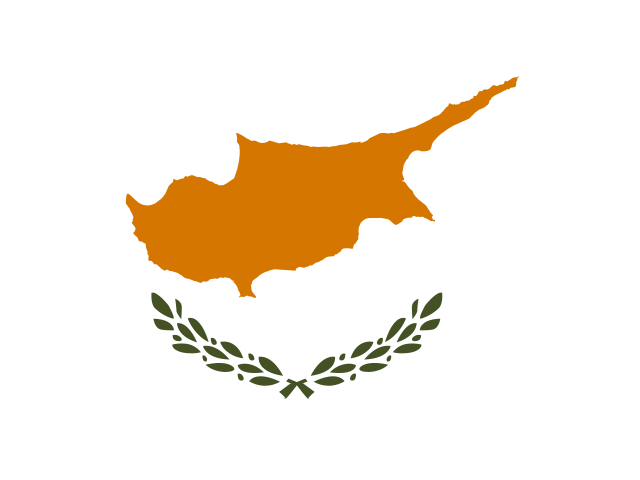
The Cypriot flag consists of a white field with a copper-orange silhouette of the island of Cyprus in the center, above two crossed green olive branches. The proportion is 3:5. It was adopted on 16 August 1960, when Cyprus gained independence from Britain, following a design competition that sought a symbol free of Greek or Turkish associations.
Colors and meaning
White represents peace and the desire for peaceful coexistence between the Greek Cypriot and Turkish Cypriot communities, copper represents the island's copper ore deposits — for which Cyprus has been famous since antiquity — and the green olive branches represent peace and the two communities of the island.
White field
Represents peace and the desire for peaceful coexistence between the Greek Cypriot and Turkish Cypriot communities. The use of white was deliberate — it was chosen to avoid the blue and red of the Greek flag and the red and white of the Turkish flag, both of which were associated with one community or the other.
Copper island silhouette
The copper-orange silhouette of Cyprus represents the island's copper ore deposits, which have been mined since the Bronze Age. The name 'Cyprus' is derived from the Greek word for copper (kypros), and the island was a major source of copper for the ancient Mediterranean world. The specific shade of copper used on the flag is a deliberate reference to this heritage.
Olive branches
The two crossed green olive branches beneath the island represent peace and the two main communities of Cyprus — the Greek Cypriots and the Turkish Cypriots. The olive branch has been a symbol of peace since antiquity and is mentioned in both Greek and Turkish traditions.
Design intention
The flag was designed to be neutral — it deliberately avoids both the blue and white of the Greek flag and the red and white of the Turkish flag. The design was chosen through a competition in 1960, and the winning design was by İsmet Güney, a Turkish Cypriot artist.
History and adoption
Cyprus was a British colony from 1878 until 1960, when it gained independence on 16 August 1960 after a four-year armed struggle by the Greek Cypriot EOKA movement. The new republic needed a flag that would represent both the Greek Cypriot and Turkish Cypriot communities, so a design competition was held. The winning design, by Turkish Cypriot artist İsmet Güney, featured a copper-orange silhouette of the island above two crossed olive branches on a white field. The flag was adopted on 16 August 1960, the day of independence, and has remained the flag of the internationally recognized Republic of Cyprus since — though it is not used in the Turkish-occupied northern part of the island, which uses the flag of the Turkish Republic of Northern Cyprus (recognized only by Turkey).
Key facts
- Adopted
- 16 August 1960
- Proportion
- 3:5
- Designer
- İsmet Güney
- Capital
- Nicosia
- Country code
- CY
- Similar flags
- None
Historical and related flags
Cyprus has used several flags across its Ottoman, British and independence periods.
- Ottoman Cyprus (1571–1878): Ottoman flag used during Ottoman rule.
- British Cyprus (1878–1960): British Blue Ensign with a colonial badge featuring two lions.
- Current flag (1960–present): White field with copper island and olive branches.
- Presidential standard: Uses the Cypriot coat of arms with a dove and olive branch.
- Northern Cyprus flag (1984–present): White field with red crescent and star and two red stripes, used by the unrecognized Turkish Republic of Northern Cyprus.
Frequently asked questions
What does the flag of Cyprus look like?
The flag of Cyprus is a white field with a copper-orange outline of the island of Cyprus in the center, above two crossed green olive branches. The proportion is 3:5.
When was the flag of Cyprus adopted?
The current flag of Cyprus was officially adopted on 16 August 1960.
What do the colors mean?
White represents peace and the desire for peaceful coexistence between the Greek Cypriot and Turkish Cypriot communities, copper represents the island's copper ore deposits — for which Cyprus has been famous since antiquity — and the green olive branches represent peace and the two communities of the island.
Which flags look similar to the Cyprus flag?
No other national flag closely resembles Cyprus's. The combination of a white field with a copper island silhouette and crossed olive branches is unique.

 Greece
 Turkey
 Lebanon
 Israel
 Syria
 Malta