What the flag looks like
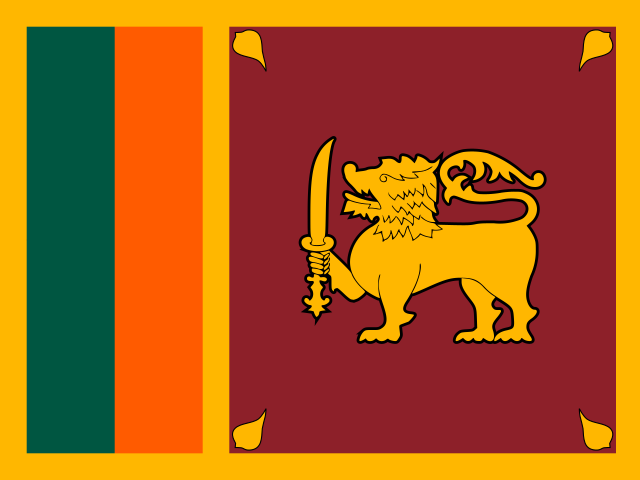
The Sri Lankan flag, known as the Lion Flag, features a golden lion holding a sword in its right forepaw on a crimson field, with a golden border on all sides. On the hoist side are two vertical stripes — green on the left and orange on the right — separated from the lion panel by a golden band. The proportion is 1:2. The design was adopted on 22 May 1972, when Sri Lanka became a republic.
Colors and meaning
The golden lion represents the Sinhalese people and the ancient Kingdom of Kandy, the crimson field represents the blood shed for Sri Lankan independence, the green stripe represents the Muslim and Moor community, and the orange stripe represents the Tamil community — together symbolizing the unity of Sri Lanka's diverse ethnic groups.
Golden lion
The lion holding a sword represents the Sinhalese people and their ancient kingdoms. The lion has been a symbol of Sri Lanka since at least the 5th century and was the emblem of the Kingdom of Kandy, the last independent kingdom before British rule.
Crimson field
Represents the blood shed by Sri Lankan patriots in the struggle for independence and the courage of the Sinhalese people. Crimson was the traditional color of the Sinhalese flag since ancient times.
Green stripe
Represents the Sri Lankan Muslim and Moor community, one of the country's main minority groups.
Orange stripe
Represents the Sri Lankan Tamil community, another major minority group. The orange color was traditionally associated with Tamil culture in Sri Lanka.
Golden border
Symbolizes the unity of the nation and surrounds the entire flag, connecting the lion panel with the two minority stripes.
History and adoption
The lion flag of Sri Lanka dates back to at least the 5th century, when it was used by the kingdom of Kandy and earlier Sinhalese kingdoms. The last king of Kandy, Sri Wickrama Rajasinha, used a similar lion flag before the British captured him in 1815. The flag was revived during the Sri Lankan independence movement in the early 20th century. On 4 February 1948, when Sri Lanka (then Ceylon) gained independence from Britain, the Lion Flag was adopted as the national flag. The green and orange stripes were added in 1951 to represent the Muslim and Tamil minorities. The design was formally standardized on 22 May 1972, when Sri Lanka became a republic. It has remained unchanged since.
Key facts
- Adopted
- 22 May 1972
- Proportion
- 1:2
- Designer
- Traditional design, standardized by the Sri Lankan government
- Capital
- Sri Jayawardenepura Kotte (legislative), Colombo (executive/judicial)
- Country code
- LK
- Similar flags
- None
Historical and related flags
Sri Lanka has used several flags across its ancient kingdoms, colonial period and independence.
- Kingdom of Kandy (15th–18th century): Crimson field with a golden lion holding a sword.
- British Ceylon (1815–1948): British Blue Ensign with a colonial badge.
- First independence flag (1948–1951): Lion flag without minority stripes.
- Second flag (1951–1972): Lion flag with green and orange stripes added.
- Current flag (1972–present): Standardized proportions and design.
- Presidential standard: Uses the Sri Lankan coat of arms with a lion and other national symbols.
Frequently asked questions
What does the flag of Sri Lanka look like?
The flag of Sri Lanka has a golden lion holding a sword on a crimson field, with a golden border. On the hoist side are two vertical stripes — green and orange — separated from the lion panel by a golden border. The proportion is 1:2.
When was the flag of Sri Lanka adopted?
The current flag of Sri Lanka was officially adopted on 22 May 1972.
What do the colors mean?
The golden lion represents the Sinhalese people and the ancient Kingdom of Kandy, the crimson field represents the blood shed for Sri Lankan independence, the green stripe represents the Muslim and Moor community, and the orange stripe represents the Tamil community — together symbolizing the unity of Sri Lanka's diverse ethnic groups.
Which flags look similar to the Sri Lanka flag?
No other national flag closely resembles Sri Lanka's. The combination of a golden lion holding a sword on a crimson field with green and orange hoist stripes is unique.

 India
 Maldives
 Bangladesh
 Pakistan
 Nepal
 Myanmar