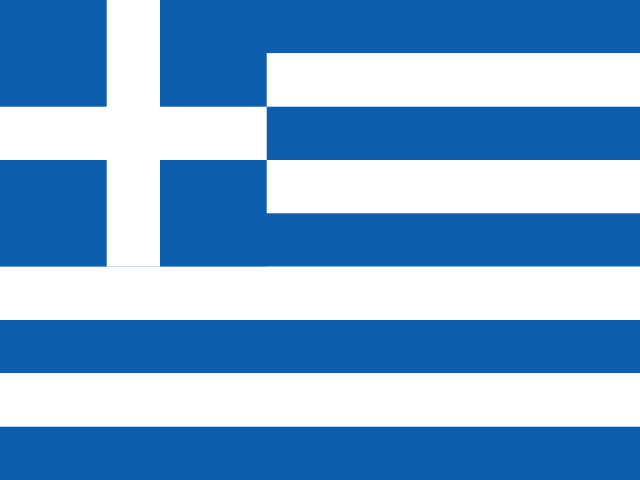
What the flag looks like
The Greek flag consists of nine equal horizontal stripes of blue and white, alternating with blue at the top and bottom, and a blue square in the upper hoist corner bearing a white cross. The proportion is 2:3. It was adopted on 22 December 1978, replacing the earlier variant used by the Greek military and merchant marine. The design has been in use since the Greek War of Independence in 1822.
Colors and meaning
Blue represents the sky, the sea and the Greek Orthodox faith, and white represents purity, peace and the snow of the Greek mountains. The nine stripes are said to represent the nine syllables of the phrase 'Ελευθερία ή Θάνατος' ('Freedom or Death'), the motto of the Greek War of Independence. The cross represents Greek Orthodoxy.
Blue
Represents the sky, the Aegean and Ionian seas, and the Greek Orthodox faith. The shade of blue has varied over time — the current official shade is a medium blue.
White
Represents purity, peace and, in some interpretations, the snow of the Greek mountains and the white of Greek marble.
Nine stripes
Represents the nine syllables of 'Ελευθερία ή Θάνατος' ('Freedom or Death'), the rallying cry of the Greek War of Independence.
Cross
The white cross on a blue field represents Greek Orthodox Christianity, the dominant religion of Greece and a central part of Greek national identity.
History and adoption
The Greek flag was adopted on 15 March 1822 by the First National Assembly at Epidaurus, during the Greek War of Independence against the Ottoman Empire. The original design had a white cross on a blue field for use on land and a blue-and-white striped flag for use at sea. In 1828, the striped flag with a cross in the canton was adopted for all uses. The flag was retained after independence and through the monarchy, with the crown briefly added in the center during the royal period. The current design was formally adopted on 22 December 1978, after the fall of the military junta and the establishment of the Third Hellenic Republic.
Key facts
- Adopted
- 22 December 1978
- Proportion
- 2:3
- Designer
- Unknown — designed during the Greek War of Independence
- Capital
- Athens
- Country code
- GR
- Similar flags
- Uruguay, Israel
Historical and related flags
Greece has used several flag designs across the revolution, monarchy and republican periods.
- Revolutionary land flag (1822): White cross on a blue field.
- Revolutionary sea flag (1822): Nine blue-and-white stripes with a cross in the canton.
- Kingdom of Greece (1833–1924): Striped flag with a royal crown in the center.
- Second Hellenic Republic (1924–1935): Plain striped flag without the crown.
- Kingdom of Greece (1935–1973): Crown restored.
- Current flag (1978–present): Striped flag without the crown.
Frequently asked questions
What does the flag of Greece look like?
The flag of Greece has nine horizontal stripes of blue and white, with a white cross on a blue square in the upper hoist corner. The proportion is 2:3.
When was the flag of Greece adopted?
The current flag of Greece was officially adopted on 22 December 1978.
What do the colors mean?
Blue represents the sky, the sea and the Greek Orthodox faith, and white represents purity, peace and the snow of the Greek mountains. The nine stripes are said to represent the nine syllables of the phrase 'Ελευθερία ή Θάνατος' ('Freedom or Death'), the motto of the Greek War of Independence. The cross represents Greek Orthodoxy.
Which flags look similar to the Greece flag?
Uruguay uses nine blue-and-white stripes with the Sun of May in the canton. Israel uses a white field with two blue stripes and the Star of David. Greece's cross canton is unique among these.

 Cyprus
 Turkey
 Italy
 Uruguay
 Israel
 North Macedonia