What the flag looks like
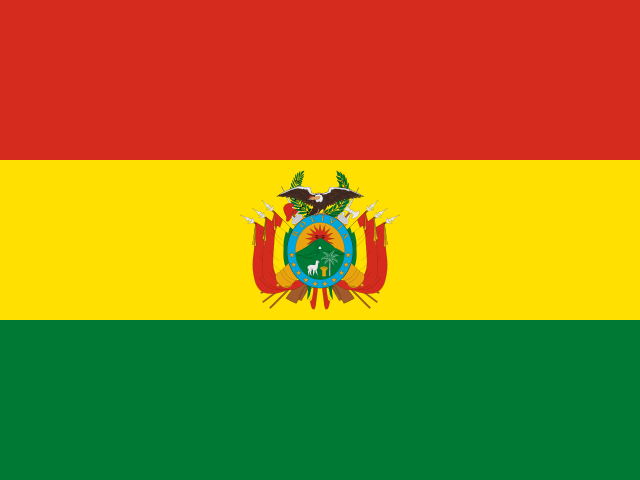
The Bolivian flag consists of three equal horizontal bands of red (top), yellow (middle) and green (bottom). The state flag (bandera de Estado) includes the Bolivian coat of arms in the center of the yellow band. The proportion is 2:3. It was adopted on 31 October 1851 and confirmed by the Constitution of 2009 as the official flag of the Plurinational State of Bolivia, alongside the Wiphala.
Colors and meaning
Red represents the blood shed by Bolivian patriots in the struggle for independence and the nation's bravery, yellow represents Bolivia's mineral wealth and fertile soil, and green represents the country's rich natural environment and hope for the future.
Red
Represents the blood shed by Bolivian patriots during the long struggle for independence from Spain, achieved in 1825, and the bravery and courage of the Bolivian people.
Yellow
Represents Bolivia's mineral wealth, particularly its silver, tin and lithium reserves, and the fertility of its soil.
Green
Represents Bolivia's rich natural environment, its forests and agriculture, and hope for the future. Bolivia has some of the most biodiverse territory in the world.
Coat of arms (state flag)
The state flag includes the Bolivian coat of arms, which features a central oval with a mountain (Potosí), a sun, a condor, a llama, a sheaf of wheat and a cannon, surrounded by Bolivian flags, rifles, an axe and a Phrygian cap representing liberty.
Wiphala
Since 2009, the Wiphala — a square patchwork flag of seven colors representing Andean indigenous peoples — is officially recognized as a national symbol of Bolivia alongside the tricolor.
History and adoption
Bolivia declared independence from Spain on 6 August 1825, and used several flag designs in its early years. The first flag, adopted in 1825, was a red-green-red horizontal tricolor. A second design in 1826 added a yellow band and the coat of arms. The current red-yellow-green tricolor was adopted on 31 October 1851 under President Manuel Isidoro Belzu. Since then, the tricolor has remained unchanged, though the coat of arms has been modified several times. In 2009, the new Constitution of Bolivia recognized the Wiphala as a second national symbol alongside the tricolor.
Key facts
- Adopted
- 31 October 1851
- Proportion
- 2:3
- Designer
- Manuel Isidoro Belzu (current design)
- Capital
- Sucre (constitutional), La Paz (seat of government)
- Country code
- BO
- Similar flags
- Lithuania, Ghana, Ethiopia
Historical and related flags
Bolivia has used several flags across its colonial, independence and republican periods, and today uses several official variants.
- First flag (1825): Red-green-red horizontal tricolor.
- Second flag (1826–1851): Red-yellow-green tricolor with the coat of arms.
- Current flag (1851–present): Red-yellow-green tricolor.
- State flag (bandera de Estado): Tricolor with the coat of arms in the center.
- Naval ensign: Tricolor with a naval emblem.
- Wiphala (2009–present): Officially recognized national symbol of Andean indigenous peoples.
Frequently asked questions
What does the flag of Bolivia look like?
The flag of Bolivia has three equal horizontal bands of red (top), yellow (middle) and green (bottom). The state flag adds the Bolivian coat of arms in the center. The proportion is 2:3.
When was the flag of Bolivia adopted?
The current flag of Bolivia was officially adopted on 31 October 1851.
What do the colors mean?
Red represents the blood shed by Bolivian patriots in the struggle for independence and the nation's bravery, yellow represents Bolivia's mineral wealth and fertile soil, and green represents the country's rich natural environment and hope for the future.
Which flags look similar to the Bolivia flag?
Lithuania uses yellow-green-red — the same colors in a different order. Ghana uses red-yellow-green with a black star in the center. Bolivia's plain red-yellow-green tricolor is unique among national flags.

 Peru
 Chile
 Argentina
 Paraguay
 Brazil
 Ecuador