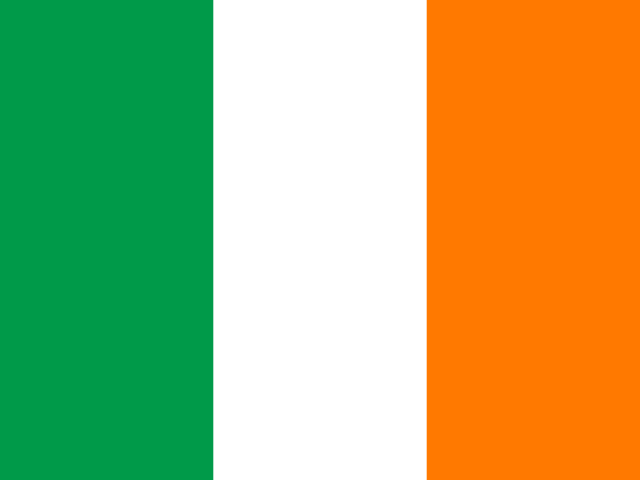
What the flag looks like
The Irish flag consists of three equal vertical bands of green (hoist), white (center) and orange (fly). The proportion is 1:2, twice as wide as it is tall. It was first raised publicly in 1848 by Thomas Francis Meagher and was formally adopted as the national flag of Ireland on 29 December 1937, when the Constitution of Ireland came into force.
Colors and meaning
Green represents the Gaelic and Catholic tradition of Ireland, orange represents the Protestant and Unionist tradition descended from William of Orange, and white in the center represents a lasting peace and truce between the two communities. The design is meant to symbolize the unity of all Irish people regardless of religion.
Green
Represents the Gaelic, Catholic and nationalist tradition of Ireland. Green has been associated with Irish nationalism since the 18th century, notably through the Society of United Irishmen.
Orange
Represents the Protestant and Unionist tradition, named after William of Orange, whose victory at the Battle of the Boyne in 1690 is commemorated by the Orange Order.
White
Represents peace, unity and a permanent truce between the two communities. Placed between green and orange, it is meant to reflect the ideal of harmony.
Origin
The design was introduced in 1848 by Thomas Francis Meagher, a leader of the Young Ireland movement, who brought a version of it from France as a gift from French republicans.
History and adoption
The Irish tricolor was first raised publicly on 7 March 1848 by Thomas Francis Meagher at the Wolf Tone Club in Dublin. The design was inspired by the French Tricolore and intended to symbolize the union of Irish Catholics and Protestants. It was used by the Easter Rising in 1916 and became the flag of the Irish Free State in 1922. It was formally adopted as the national flag of Ireland on 29 December 1937, when the Constitution of Ireland (Bunreacht na hÉireann) came into force. The flag has remained unchanged since.
Key facts
- Adopted
- 29 December 1937
- Proportion
- 1:2
- Designer
- Thomas Francis Meagher (introduced)
- Capital
- Dublin
- Country code
- IE
- Similar flags
- Italy, Mexico, Ivory Coast
Historical and related flags
Ireland has used several flags before the tricolor was adopted, and the island of Ireland uses different flags across the island today.
- Kingdom of Ireland (1542–1801): Blue flag with a golden harp.
- St Patrick's Saltire (1783–1801): Red cross on white, used to represent Ireland in the Union Jack.
- Green flag with harp (17th–19th century): Used by Irish nationalists and the United Irishmen.
- Irish Free State (1922–1937): Tricolor used unofficially as the national flag.
- Republic of Ireland (1937–present): Tricolor formally adopted by the Constitution.
- Northern Ireland: Uses the Ulster Banner in sporting events, not the tricolor.
Frequently asked questions
What does the flag of Ireland look like?
The flag of Ireland has three equal vertical bands of green, white and orange. The proportion is 1:2.
When was the flag of Ireland adopted?
The current flag of Ireland was officially adopted on 29 December 1937.
What do the colors mean?
Green represents the Gaelic and Catholic tradition of Ireland, orange represents the Protestant and Unionist tradition descended from William of Orange, and white in the center represents a lasting peace and truce between the two communities. The design is meant to symbolize the unity of all Irish people regardless of religion.
Which flags look similar to the Ireland flag?
Italy and Mexico use vertical green-white-red tricolors, with different shades of red. Ivory Coast uses orange-white-green, the reverse of Ireland's. Ireland's specific green-orange combination is unique.

 United Kingdom
 Italy
 Mexico
 Ivory Coast
 France
 Norway