What the flag looks like
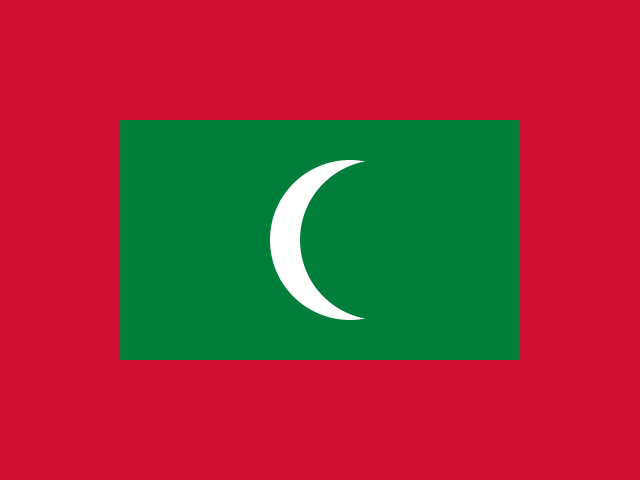
The Maldivian flag consists of a red field with a green rectangle in the center, and within the green rectangle a white crescent moon facing the hoist. The proportion is 2:3. It was adopted on 25 July 1965, when the Maldives gained independence from Britain, and has remained unchanged since, including when the country became a republic in 1968.
Colors and meaning
Red represents the blood shed by Maldivian patriots in the struggle for independence and the courage of the Maldivian people, green represents the country's lush tropical vegetation and Islam — the dominant religion of the Maldives — and the white crescent moon represents Islam and peace.
Red field
Represents the blood shed by Maldivian patriots in the struggle for independence from Britain, achieved in 1965, and the courage, sacrifice and determination of the Maldivian people. Red is also a traditional color of Maldivian royalty and appears on historic Maldivian flags.
Green rectangle
Represents the lush tropical vegetation of the Maldives — an archipelago of 1,192 coral islands, of which about 200 are inhabited. Green is also the traditional color of Islam, the official religion of the Maldives, and it appears on many Muslim national flags.
White crescent
Represents Islam, the official religion of the Maldives since the 12th century, and peace. The crescent is oriented facing the hoist side of the flag, unlike most other crescent flags, and its vertical orientation is a distinctive feature of the Maldivian flag.
Design origin
The design has its origins in the 19th century, when the Maldives used a plain red flag with a white crescent. During the reign of Sultan Muhammad Shamsuddeen III (1902–1935), the flag was changed to add a green rectangle with a white crescent, reflecting the Islamic faith and the country's tropical environment. The current design was formally adopted on 25 July 1965, when the Maldives gained independence from Britain. It has remained unchanged since, including when the Maldives became a republic in 1968.
History and adoption
The Maldives was a British protectorate from 1887 until 1965, when it gained independence on 26 July 1965. The flag was adopted on 25 July 1965, the day before independence. The design was based on a flag introduced in the early 20th century, which featured a green rectangle with a white crescent on a red field. The Maldives became a republic in 1968 and retained the flag unchanged. It has remained the same since, including through the political changes of the following decades.
Key facts
- Adopted
- 25 July 1965
- Proportion
- 2:3
- Designer
- Based on a design introduced during the reign of Sultan Muhammad Shamsuddeen III
- Capital
- Malé
- Country code
- MV
- Similar flags
- Turkey, Tunisia
Historical and related flags
The Maldives used several flags across its sultanate and British protectorate periods.
- Sultanate of Maldives (pre-1900s): Plain red flag, sometimes with a white crescent.
- Sultanate of Maldives (1900s–1953): Red field with green rectangle and white crescent.
- First Republic (1953–1954): Same design retained.
- Restored Sultanate (1954–1965): Same design retained.
- Current flag (1965–present): Red field with green rectangle and white crescent, adopted at independence.
- Presidential standard: Uses the Maldivian coat of arms with a coconut palm, a crescent and two crossed national flags.
Frequently asked questions
What does the flag of Maldives look like?
The flag of Maldives is a red field with a green rectangle in the center bearing a white vertical crescent moon. The proportion is 2:3.
When was the flag of Maldives adopted?
The current flag of Maldives was officially adopted on 25 July 1965.
What do the colors mean?
Red represents the blood shed by Maldivian patriots in the struggle for independence and the courage of the Maldivian people, green represents the country's lush tropical vegetation and Islam — the dominant religion of the Maldives — and the white crescent moon represents Islam and peace.
Which flags look similar to the Maldives flag?
Turkey and Tunisia use red fields with white crescents and stars. Pakistan uses a green field with a white crescent and star. The Maldives' red field with a green rectangle and a white vertical crescent is unique.

 Sri Lanka
 India
 Mauritius
 Seychelles
 Pakistan
 Bangladesh