What the flag looks like
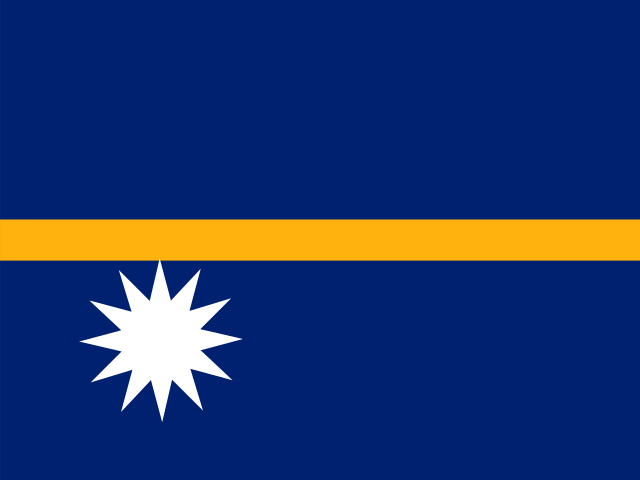
The Nauruan flag consists of a dark blue field divided by a golden-yellow horizontal stripe running across the center. Below the stripe, on the hoist side, is a white twelve-pointed star. The proportion is 1:2. It was adopted on 31 January 1968, when Nauru gained independence from Australia, New Zealand and Britain, and has remained unchanged since.
Colors and meaning
The dark blue field represents the Pacific Ocean that surrounds Nauru, the golden-yellow stripe represents the equator — Nauru is located just south of the equator — and the white twelve-pointed star represents the island's twelve original tribes.
Dark blue field
Represents the Pacific Ocean that surrounds Nauru — the world's smallest island nation, with a total land area of just 21 square kilometers. Blue also represents the sky over the island.
Golden-yellow stripe
Represents the equator, which passes very close to Nauru's latitude. The stripe divides the flag horizontally, echoing the way the equator divides the Pacific Ocean. Yellow also represents the phosphate mining that brought Nauru great wealth in the 20th century.
Twelve-pointed white star
Represents the twelve original tribes of Nauru — the Deiboe, Eamwidamit, Eamwidara, Eamwit, Eamgum, Eano, Emeo, Eoraru, Irutsi, Iruwa, Iwi and Ranibok. The twelve points of the star symbolize the unity of the twelve tribes, who still play an important role in Nauruan culture and land ownership. The star is positioned below the equatorial stripe, reflecting Nauru's position just south of the equator.
Design origin
The flag was designed in a national competition in 1968, in preparation for independence from the joint Australian, New Zealand and British administration. The winning design was created by a Nauruan artist and reflects the country's geography and cultural heritage. It was adopted on 31 January 1968, Nauru's independence day.
History and adoption
Nauru was annexed by Germany in 1888, then captured by Australia during World War I and administered by Australia, New Zealand and Britain under a League of Nations mandate and later a United Nations trust territory. During the 20th century, the island's phosphate deposits were mined extensively, bringing great wealth but also severe environmental damage. Nauru gained independence on 31 January 1968, becoming the world's smallest independent republic. The current flag was adopted on independence day, following a design competition. It has remained unchanged since.
Key facts
- Adopted
- 31 January 1968
- Proportion
- 1:2
- Designer
- Based on a design submitted in a national competition
- Capital
- Yaren (de facto)
- Country code
- NR
- Similar flags
- None
Historical and related flags
Nauru used several flags during its German, Australian and British colonial periods before independence.
- German New Guinea (1888–1914): German colonial flags.
- British and Australian mandate (1914–1947): British and Australian flags used jointly.
- UN trust territory (1947–1968): Australian flag used during administration.
- Current flag (1968–present): Dark blue with golden equatorial stripe and white twelve-pointed star.
- Presidential standard: Uses the Nauruan coat of arms with a frigatebird, coconut palm and shark.
Frequently asked questions
What does the flag of Nauru look like?
The flag of Nauru is a dark blue field with a golden-yellow horizontal stripe across the center, and a white twelve-pointed star just below the stripe on the hoist side. The proportion is 1:2.
When was the flag of Nauru adopted?
The current flag of Nauru was officially adopted on 31 January 1968.
What do the colors mean?
The dark blue field represents the Pacific Ocean that surrounds Nauru, the golden-yellow stripe represents the equator — Nauru is located just south of the equator — and the white twelve-pointed star represents the island's twelve original tribes.
Which flags look similar to the Nauru flag?
No other national flag closely resembles Nauru's. The combination of a dark blue field with a golden equatorial stripe and a white twelve-pointed star is unique.

 Kiribati
 Tuvalu
 Marshall Islands
 Palau
 Micronesia
 Australia