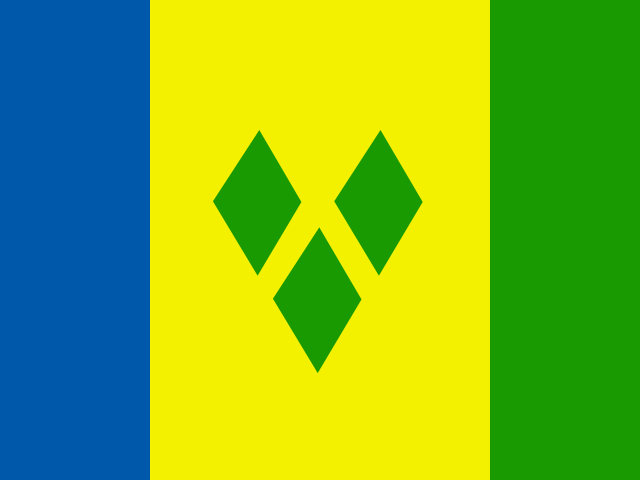
What the flag looks like
The flag of Saint Vincent and the Grenadines consists of three vertical bands — blue on the hoist, a wider gold band in the center, and green on the fly — with three green diamonds arranged in a V (or chevron) pattern in the center of the gold band. The proportion is 2:3. It was adopted on 21 October 1985, replacing an earlier design used since independence in 1979.
Colors and meaning
Blue represents the Caribbean Sea and the Atlantic Ocean that surround the islands, gold represents the warmth of the Vincentian people and the Caribbean sunshine, and green represents the country's lush vegetation and agricultural wealth. The three green diamonds represent the country's name — 'Saint Vincent' — and are arranged in a V shape to represent the 'V' of the island's name, and they also reference the three main islands of the Grenadines that are part of the country.
Blue band
Represents the Caribbean Sea to the west and the Atlantic Ocean to the east, and the blue skies over the island chain. Blue also represents the country's maritime heritage and the importance of fishing and tourism to its economy.
Gold band
Represents the warmth and friendliness of the Vincentian people and the Caribbean sunshine that shines on the islands year-round. Gold also represents the country's sandy beaches and the bright future of the nation.
Green band
Represents the lush vegetation and agricultural wealth of Saint Vincent and the Grenadines. The main island of Saint Vincent is known for its dense rainforests and for being the 'Breadbasket of the Grenadines'.
Three green diamonds
Represent the three main islands that make up the country's Grenadine portion — Bequia, Mustique and Union Island — as well as the 'V' shape of the main island of Saint Vincent. The diamonds are arranged in a V pattern and are sometimes also said to represent the three pillars of the country's society: faith, hope and charity.
Design origin
The flag was designed in a national competition and adopted on 21 October 1985, replacing the earlier flag that had been used since independence in 1979 (which featured a blue, yellow and green tricolor with a breadfruit leaf and the coat of arms). The new design was chosen to be simpler and more distinctive, and has remained unchanged since.
History and adoption
Saint Vincent and the Grenadines was a British colony from 1783 until 1979, when it gained full independence on 27 October 1979 as a Commonwealth realm. The first flag, adopted at independence, featured vertical bands of blue, yellow and green with a breadfruit leaf in the center (a reference to the island's history and agriculture) and the national coat of arms. This design was replaced on 21 October 1985 with the current flag, which simplified the central emblem to the three green diamonds. The current flag has remained unchanged since.
Key facts
- Adopted
- 21 October 1985
- Proportion
- 2:3
- Designer
- Based on a design from a national competition
- Capital
- Kingstown
- Country code
- VC
- Similar flags
- None
Historical and related flags
Saint Vincent and the Grenadines used several flags during its French, British and independence periods.
- French Saint Vincent (1719–1763): French colonial flags.
- British Saint Vincent (1763–1958): British Blue Ensign with a colonial badge.
- West Indies Federation (1958–1962): Blue field with four white wavy stripes and a yellow sun.
- Associated state (1969–1979): Blue Ensign with an updated badge.
- First independence flag (1979–1985): Blue, yellow and green bands with a breadfruit leaf and coat of arms.
- Current flag (1985–present): Blue, gold and green bands with three green diamonds.
- Governor-General's standard: Uses the Vincentian coat of arms with two women holding a palm frond and a peace plant.
Frequently asked questions
What does the flag of Saint Vincent and the Grenadines look like?
The flag of Saint Vincent and the Grenadines has three vertical bands — blue on the hoist, a wider gold band in the center, and green on the fly — with three green diamond shapes arranged in a V pattern in the center of the gold band. The proportion is 2:3.
When was the flag of Saint Vincent and the Grenadines adopted?
The current flag of Saint Vincent and the Grenadines was officially adopted on 21 October 1985.
What do the colors mean?
Blue represents the Caribbean Sea and the Atlantic Ocean that surround the islands, gold represents the warmth of the Vincentian people and the Caribbean sunshine, and green represents the country's lush vegetation and agricultural wealth. The three green diamonds represent the country's name — 'Saint Vincent' — and are arranged in a V shape to represent the 'V' of the island's name, and they also reference the three main islands of the Grenadines that are part of the country.
Which flags look similar to the Saint Vincent and the Grenadines flag?
No other national flag closely resembles Saint Vincent and the Grenadines'. The combination of blue, gold and green vertical bands with three green diamonds in a V pattern is unique.

 Grenada
 Saint Lucia
 Barbados
 Trinidad and Tobago
 Dominica
 Guyana