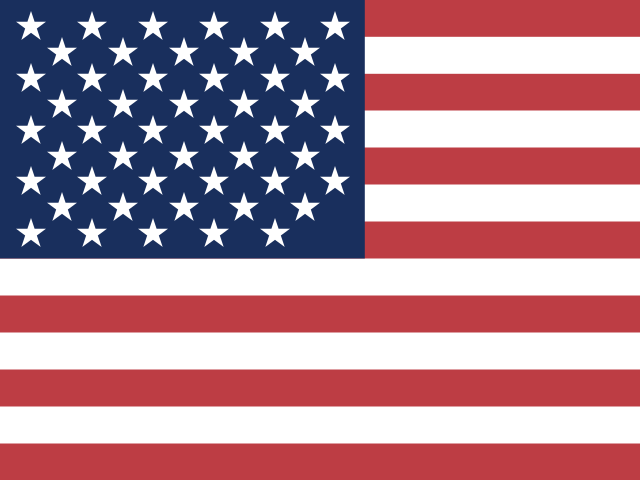
What the flag looks like
The United States flag consists of 13 equal horizontal stripes of red and white, alternating with red at the top and bottom, and a blue rectangle in the canton bearing 50 white five-pointed stars arranged in nine offset rows. The proportion is 10:19. The flag has been modified 26 times since 1777, most recently on 4 July 1960 with the admission of Hawaii.
Colors and meaning
Red represents hardiness and valor, white represents purity and innocence, and blue represents vigilance, perseverance and justice. The 13 stripes represent the original 13 colonies that declared independence from Britain, and the 50 stars represent the current 50 states.
Red
Represents hardiness and valor, and the blood shed in the fight for independence.
White
Represents purity and innocence.
Blue
Represents vigilance, perseverance and justice, and is the color of the canton field.
Thirteen stripes
Represent the 13 British colonies that declared independence in 1776: Delaware, Pennsylvania, New Jersey, Georgia, Connecticut, Massachusetts, Maryland, South Carolina, New Hampshire, Virginia, New York, North Carolina and Rhode Island.
Fifty stars
One star for each state. A new star is added on the 4th of July following the admission of a new state.
History and adoption
The first American flag was adopted by the Continental Congress on 14 June 1777, though the exact origin of the design is uncertain. The popular legend credits Betsy Ross, but no contemporary evidence confirms her role. The flag has been modified 26 times since — once for each new state admitted to the union. The current 50-star version was adopted on 4 July 1960 after Hawaii became the 50th state. The 48-star version, in use from 1912 to 1959, was the longest-serving version of the flag.
Key facts
- Adopted
- 14 June 1777 (current version 4 July 1960)
- Proportion
- 10:19
- Designer
- Francis Hopkinson (attributed)
- Capital
- Washington, D.C.
- Country code
- US
- Similar flags
- Liberia, Malaysia
Historical and related flags
The US flag has been redesigned 26 times. Each redesign added a star for a new state.
- 1777–1795: 13 stars and 13 stripes (the original Stars and Stripes).
- 1795–1818: 15 stars and 15 stripes after Vermont and Kentucky joined — this is the flag that inspired the national anthem.
- 1818–1819: 20 stars, 13 stripes (stripes reverted to 13).
- 1912–1959: 48 stars, the longest-serving version.
- 1959–1960: 49 stars after Alaska joined.
- 1960–present: 50 stars after Hawaii joined.
Frequently asked questions
What does the flag of United States look like?
The flag of the United States has 13 horizontal stripes of red and white, and a blue canton with 50 white stars. The stripes represent the original 13 colonies, and the stars represent the 50 states.
When was the flag of United States adopted?
The current flag of United States was officially adopted on 14 June 1777 (current version 4 July 1960).
What do the colors mean?
Red represents hardiness and valor, white represents purity and innocence, and blue represents vigilance, perseverance and justice. The 13 stripes represent the original 13 colonies that declared independence from Britain, and the 50 stars represent the current 50 states.
Which flags look similar to the United States flag?
Liberia uses a similar striped design with a single star in the canton. Malaysia uses a 14-stripe design with a crescent and star. The US flag's 50-star canton is unique.

 Canada
 Mexico
 United Kingdom
 Liberia
 Malaysia
 Brazil