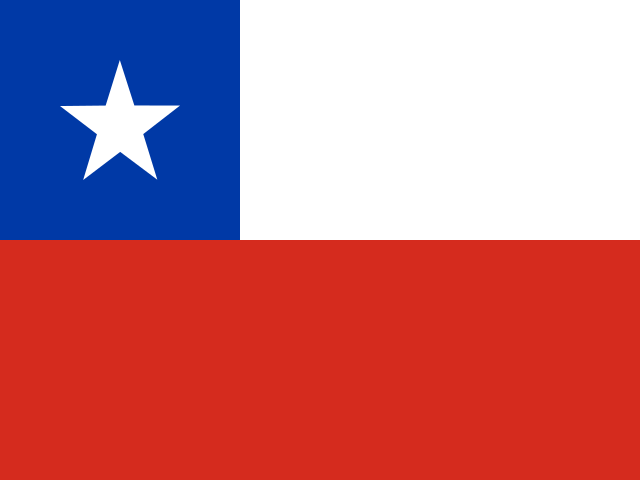
What the flag looks like
The Chilean flag is divided horizontally: the top half is split between a blue canton on the hoist side bearing a white five-pointed star and a white band on the fly side, and the bottom half is a solid red band. The proportion is 2:3. It was adopted on 18 October 1817, during the Chilean War of Independence, and is known as the Lone Star (La Estrella Solitaria).
Colors and meaning
Blue represents the sky and the Pacific Ocean, white represents the snow of the Andes mountains, and red represents the blood shed by Chilean patriots in the struggle for independence. The white star represents the guiding light of progress and honor.
Blue
Represents the clear sky over Chile and the Pacific Ocean that borders the country's entire western coast.
White
Represents the snow-capped peaks of the Andes mountains, which form Chile's eastern border and dominate its landscape.
Red
Represents the blood shed by Chilean patriots during the long struggle for independence from Spain, achieved in 1818.
White star
Represents the guiding light of progress, honor and the Chilean nation. The 'Lone Star' nickname comes from this single star, which distinguishes the flag from other South American designs.
History and adoption
The Chilean flag was designed by Bernardo O'Higgins and José Ignacio Zenteno and adopted on 18 October 1817, during the Chilean War of Independence. It was first flown officially on 12 February 1818, the day Chile declared independence. The design has remained unchanged since, making it one of the oldest flags in South America. A previous flag, known as the Flag of the Transition (1812–1814), used blue, white and yellow bands, but was replaced by the current design. The Lone Star nickname comes from its single white star.
Key facts
- Adopted
- 18 October 1817
- Proportion
- 2:3
- Designer
- Bernardo O'Higgins, José Ignacio Zenteno
- Capital
- Santiago
- Country code
- CL
- Similar flags
- Texas, Cuba, Puerto Rico
Historical and related flags
Chile has used several flags across its colonial, independence and republican periods.
- Spanish colonial (1541–1810): Spanish flag used during colonial rule.
- Old Fatherland (1812–1814): Blue, white and yellow tricolor used during early independence.
- Transition flag (1814–1817): Blue, white and red horizontal bands.
- Current flag (1817–present): Lone Star design adopted during independence.
- Presidential standard: The flag with the Chilean coat of arms in the center.
Frequently asked questions
What does the flag of Chile look like?
The flag of Chile has a blue square in the upper hoist corner bearing a white five-pointed star, with a white band below it and a red band at the bottom. The proportion is 2:3.
When was the flag of Chile adopted?
The current flag of Chile was officially adopted on 18 October 1817.
What do the colors mean?
Blue represents the sky and the Pacific Ocean, white represents the snow of the Andes mountains, and red represents the blood shed by Chilean patriots in the struggle for independence. The white star represents the guiding light of progress and honor.
Which flags look similar to the Chile flag?
The Texas state flag uses the same design with the same colors. Cuba and Puerto Rico use similar blue-and-white striped designs with a red triangle. Chile's flag is sometimes confused with the Texas flag, but Chile's is red on the bottom and Texas's is red on the top.

 Argentina
 Peru
 Bolivia
 Cuba
 Puerto Rico
 Uruguay