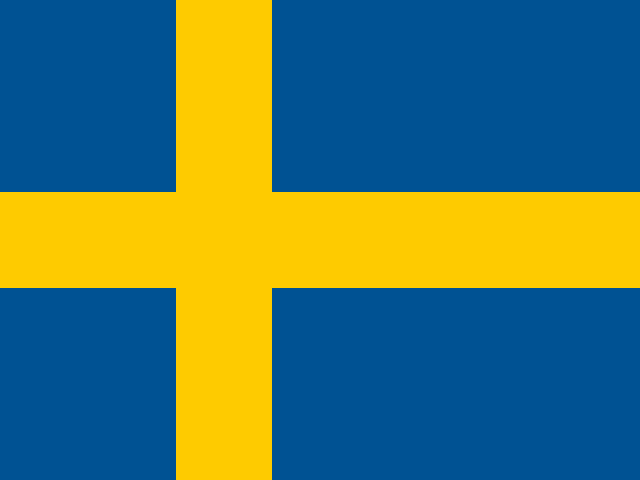
What the flag looks like
The Swedish flag consists of a blue field bearing a yellow Nordic cross, with the vertical bar offset toward the hoist. The proportion is 5:8 for the national flag (10:16 for the swallow-tailed military version). It was formally adopted on 22 June 1906, though the design has been used since the 16th century.
Colors and meaning
The colors are traditionally said to derive from the Swedish royal coat of arms — three golden crowns on a blue field — which dates back to the 14th century. Blue represents truth, loyalty and justice, and yellow represents generosity and the sun.
Blue
Represents truth, loyalty, justice and the Swedish lakes and skies. It is the field color of the Swedish royal coat of arms, which features three golden crowns on blue.
Yellow
Represents generosity, the sun and the golden crowns of the Swedish coat of arms. Historically associated with the Swedish royal family and the Church.
Nordic cross
A cross design shared by all Nordic countries — Sweden, Denmark, Norway, Finland and Iceland — representing Christianity and, in modern use, Nordic unity.
History and adoption
The blue-and-yellow flag with a cross has been used in Sweden since at least the 16th century. According to tradition, it was first flown by Swedish forces during the reign of King Gustav Vasa in the 1520s, though the earliest confirmed images date from the 1560s. The design was influenced by the Danish Dannebrog, the oldest national flag in continuous use. The Swedish flag was formally adopted on 22 June 1906, following the dissolution of the union with Norway. The date is now celebrated as Swedish National Day.
Key facts
- Adopted
- 22 June 1906
- Proportion
- 5:8
- Designer
- Traditional — derived from the Swedish royal coat of arms
- Capital
- Stockholm
- Country code
- SE
- Similar flags
- Denmark, Norway, Finland, Iceland
Historical and related flags
Sweden has used several flag designs across its history, including variants for the military and the royal family.
- Union with Norway (1814–1905): Swedish and Norwegian flags combined in the canton.
- National flag (1906–present): Blue field with a yellow Nordic cross.
- Naval ensign: Swallow-tailed with three tongues, used by the Swedish Navy.
- Royal standard: Blue field with the greater coat of arms.
- State flag: Rectangular blue field with a yellow cross, used on government buildings.
Frequently asked questions
What does the flag of Sweden look like?
The flag of Sweden is a blue field with a yellow Nordic cross that extends to the edges of the flag, with the vertical bar placed closer to the hoist side.
When was the flag of Sweden adopted?
The current flag of Sweden was officially adopted on 22 June 1906.
What do the colors mean?
The colors are traditionally said to derive from the Swedish royal coat of arms — three golden crowns on a blue field — which dates back to the 14th century. Blue represents truth, loyalty and justice, and yellow represents generosity and the sun.
Which flags look similar to the Sweden flag?
All Nordic countries use the Nordic cross. Denmark's is red with a white cross, Norway's is red with a blue cross bordered in white, Finland's is white with a blue cross, and Iceland's is blue with a red cross bordered in white. Sweden's blue-and-yellow is unique.

 Denmark
 Norway
 Finland
 Iceland
 Switzerland
 Germany