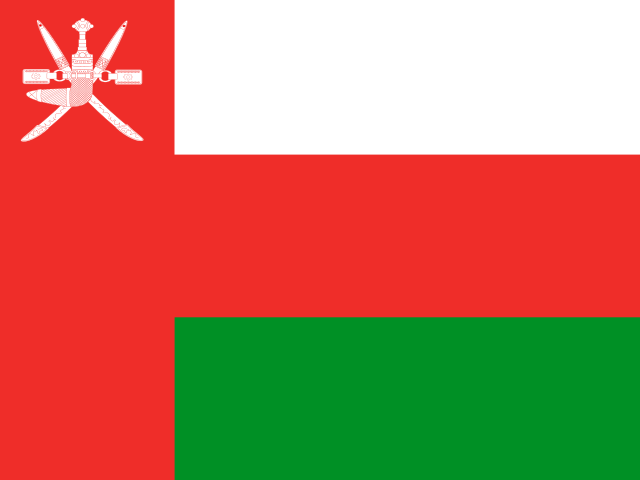
What the flag looks like
The Omani flag consists of three horizontal bands — white (top), red (middle) and green (bottom) — and a vertical red band on the hoist side. Centered on the upper part of the red hoist band is the national emblem in white: a khanjar (a traditional Omani curved dagger) crossed with two swords. The proportion is 1:2. The design was adopted on 18 November 1995, though the base design dates from 1970.
Colors and meaning
White represents peace, purity and the country's commitment to a peaceful future, red represents the blood shed in the struggle for Omani independence and the country's historic connection to the sea, and green represents the fertility of the Omani land and the Jabal Akhdar (Green Mountains). The khanjar emblem represents Oman's traditional culture and heritage.
White
Represents peace, purity and the Omani people's commitment to a peaceful and prosperous future. White is the top band of the flag.
Red
Represents the blood shed in the long struggle for Omani independence and unity, and Oman's centuries-old maritime heritage. Red has been the traditional color of Omani banners since the 18th century, when the Al Bu Sa'id dynasty established its rule.
Green
Represents the fertility of the Omani land, particularly the fertile regions of Dhofar in the south and the Al Batinah coast. Green also represents the Jabal Akhdar — the 'Green Mountains' of northern Oman.
Khanjar emblem
The khanjar is a traditional Omani curved dagger, crossed with two swords. It is a symbol of Omani heritage, culture and national identity, and is worn by Omani men on formal occasions. The emblem appears on the flag, the Omani coat of arms and the Omani currency.
History and adoption
The Al Bu Sa'id dynasty has ruled Oman since 1744, and a plain red flag was used as the Omani flag for centuries. In 1970, Sultan Qaboos bin Said overthrew his father and began a program of modernization, changing the country's name to the Sultanate of Oman. The new flag, adopted on 17 December 1970, added white and green bands to the plain red flag and placed the national emblem in the canton. The flag's proportions were standardized on 18 November 1995, and the emblem was enlarged slightly. The design has remained unchanged since, making it one of the more stable flags in the Arab world.
Key facts
- Adopted
- 18 November 1995
- Proportion
- 1:2
- Designer
- Based on the traditional Omani red banner, redesigned in 1970
- Capital
- Muscat
- Country code
- OM
- Similar flags
- None
Historical and related flags
Oman has used several flags across its dynastic and modern periods.
- Ya'rubid and early Al Bu Sa'id (17th–18th century): Plain red banners.
- Al Bu Sa'id dynasty (18th–1970): Plain red flag, sometimes with the Omani emblem.
- Muscat and Oman (1820–1970): Plain red flag used for the sultanate.
- Current flag (1970–present): White, red and green with a red hoist stripe and khanjar emblem.
- Sultan's standard: Red field with the national emblem and additional elements.
Frequently asked questions
What does the flag of Oman look like?
The flag of Oman is divided into three horizontal bands — white (top), red (middle) and green (bottom) — with a vertical red band on the hoist side bearing the white khanjar (curved dagger) emblem crossed with two swords. The proportion is 1:2.
When was the flag of Oman adopted?
The current flag of Oman was officially adopted on 18 November 1995.
What do the colors mean?
White represents peace, purity and the country's commitment to a peaceful future, red represents the blood shed in the struggle for Omani independence and the country's historic connection to the sea, and green represents the fertility of the Omani land and the Jabal Akhdar (Green Mountains). The khanjar emblem represents Oman's traditional culture and heritage.
Which flags look similar to the Oman flag?
No other national flag closely resembles Oman's. The combination of red, white and green bands with a red hoist stripe and the khanjar emblem is unique.

 Saudi Arabia
 United Arab Emirates
 Yemen
 Qatar
 Kuwait
 Iran