What the flag looks like
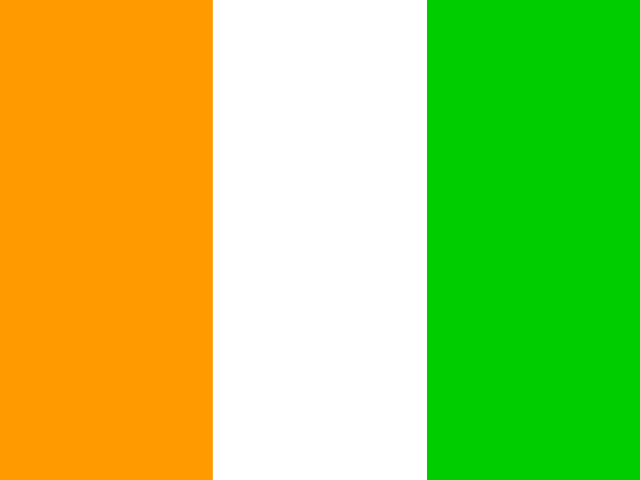
The Ivorian flag consists of three equal vertical bands of orange (hoist), white (center) and green (fly). The proportion is 2:3. It was adopted on 4 December 1959, one year before Ivory Coast gained independence from France on 7 August 1960, and has remained unchanged since.
Colors and meaning
Orange represents the fertility of the land and the savannas of the north, white represents peace and unity, and green represents hope and the forests of the south. Together the colors evoke the landscape of Ivory Coast — fertile savanna in the north, dense forest in the south — and the shared national identity of its people.
Orange
Represents the fertility of the land and the savannas of northern Ivory Coast. Orange is also the traditional color of the northern savanna and evokes the country's agricultural wealth, particularly its cocoa and coffee production.
White
Represents peace, unity and the desire for peaceful coexistence among Ivory Coast's many ethnic groups.
Green
Represents hope for the future and the forests of southern Ivory Coast. The country was named after its ivory trade, but its forests have always been a central part of its identity and economy.
Design origin
The flag was designed to resemble the French Tricolore, with which Ivory Coast shares a colonial history, but with the colors changed to represent the African landscape. It has been in use since 1959.
History and adoption
Ivory Coast became a French colony in 1893 and was part of French West Africa until 1958, when it became an autonomous republic within the French Community. The flag was adopted on 4 December 1959, in preparation for full independence, which was granted on 7 August 1960. The design was based on the French Tricolore, with orange, white and green replacing blue, white and red to represent the Ivorian landscape and identity. The flag has remained unchanged since independence, including through the political crises of the 2000s and 2010s.
Key facts
- Adopted
- 4 December 1959
- Proportion
- 2:3
- Designer
- Traditional — based on the French Tricolore
- Capital
- Yamoussoukro
- Country code
- CI
- Similar flags
- Ireland, Italy, Nigeria
Historical and related flags
Ivory Coast used several flags during its colonial period before independence.
- French colony (1893–1958): French flag used during colonial rule.
- Autonomous republic (1958–1959): French flag used during transition period.
- Current flag (1959–present): Orange, white and green vertical bands.
- Naval ensign: Uses a small Ivorian flag in the canton of a white ensign.
- Presidential standard: Uses the Ivorian coat of arms.
Frequently asked questions
What does the flag of Ivory Coast look like?
The flag of Ivory Coast has three equal vertical bands of orange (hoist), white (center) and green (fly). The proportion is 2:3.
When was the flag of Ivory Coast adopted?
The current flag of Ivory Coast was officially adopted on 4 December 1959.
What do the colors mean?
Orange represents the fertility of the land and the savannas of the north, white represents peace and unity, and green represents hope and the forests of the south. Together the colors evoke the landscape of Ivory Coast — fertile savanna in the north, dense forest in the south — and the shared national identity of its people.
Which flags look similar to the Ivory Coast flag?
Ireland uses vertical green-white-orange — the reverse of Ivory Coast. Italy uses green-white-red. Nigeria uses green-white-green. Ivory Coast's orange-white-green is unique among national flags.

 Ghana
 Nigeria
 Ireland
 Italy
 Mali
 Burkina Faso