What the flag looks like
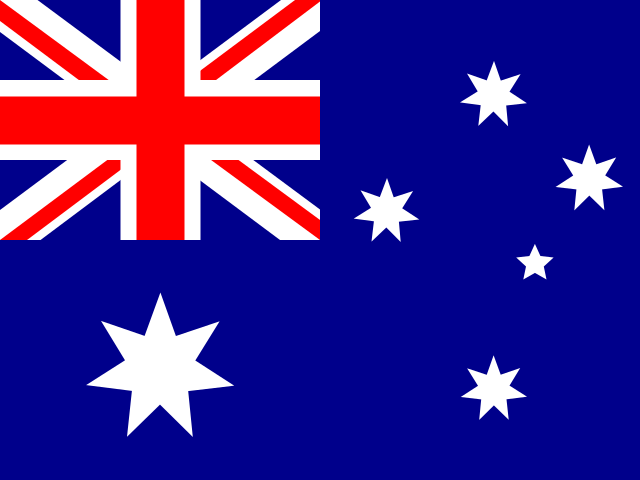
The Australian flag consists of a blue field with the Union Jack in the upper hoist quarter, a large white seven-pointed star — the Commonwealth Star — below the Union Jack, and a representation of the Southern Cross constellation in the fly half made up of five white stars. The flag proportion is 1:2.
Colors and meaning
Blue represents the sky and the ocean surrounding Australia, and the British heritage of the nation. White represents peace and honesty. Red, used in the crosses of the Union Jack, represents strength and bravery. The Commonwealth Star represents the six original states and the territories, and the Southern Cross is a constellation visible only from the Southern Hemisphere.
Blue
Represents the sky, the ocean and Australia's British heritage. The field is officially the same blue as the Union Jack.
White
Represents peace and honesty, and is used for all the stars on the flag.
Red
Appears only within the Union Jack in the canton. Represents strength, bravery and the blood shed in defense of the nation.
Commonwealth Star
A white seven-pointed star below the Union Jack. Six points represent the six original states, and the seventh point represents the territories.
Southern Cross
Five white stars (Alpha, Beta, Gamma, Delta and Epsilon Crucis) forming the constellation visible only from the Southern Hemisphere. It has been a symbol of Australia since the 1820s.
History and adoption
The Australian flag was chosen through a public design competition held after federation in 1901. Over 32,000 entries were received, and five nearly identical designs were jointly awarded the prize. The winning design combined the Union Jack, the Commonwealth Star and the Southern Cross. It was officially adopted on 3 September 1901 and has been the national flag ever since, with only minor changes to the number of points on the Commonwealth Star (from six to seven in 1908) to represent the territories.
Key facts
- Adopted
- 3 September 1901
- Proportion
- 1:2
- Designer
- Annie Dorrington, Ivor Evans, Leslie Hawkins, Egbert Nuttall and William Stevens
- Capital
- Canberra
- Country code
- AU
- Similar flags
- New Zealand
Historical and related flags
Australia has used several flags throughout its history, and the current design has only changed in minor details.
- Union Jack (pre-1901): Used as the de facto flag of the Australian colonies.
- Original 1901 flag: Commonwealth Star had only six points.
- 1903 flag: Southern Cross star sizes were standardized.
- 1908 flag: Commonwealth Star gained a seventh point for the territories.
- Current flag (1908–present): Unchanged since the seventh point was added.
- Australian Aboriginal Flag (1971): A separate flag officially recognized since 1995.
Frequently asked questions
What does the flag of Australia look like?
The flag of Australia has a blue field with the Union Jack in the canton, a large white seven-pointed Commonwealth Star below it, and five white stars of the Southern Cross on the fly half.
When was the flag of Australia adopted?
The current flag of Australia was officially adopted on 3 September 1901.
What do the colors mean?
Blue represents the sky and the ocean surrounding Australia, and the British heritage of the nation. White represents peace and honesty. Red, used in the crosses of the Union Jack, represents strength and bravery. The Commonwealth Star represents the six original states and the territories, and the Southern Cross is a constellation visible only from the Southern Hemisphere.
Which flags look similar to the Australia flag?
New Zealand's flag is nearly identical — a blue field with the Union Jack in the canton and four red stars of the Southern Cross on the fly. Australia's stars are white and it has five of them, plus the Commonwealth Star under the Union Jack.

 New Zealand
 United Kingdom
 Fiji
 Tuvalu
 Canada
 Papua New Guinea