What the flag looks like
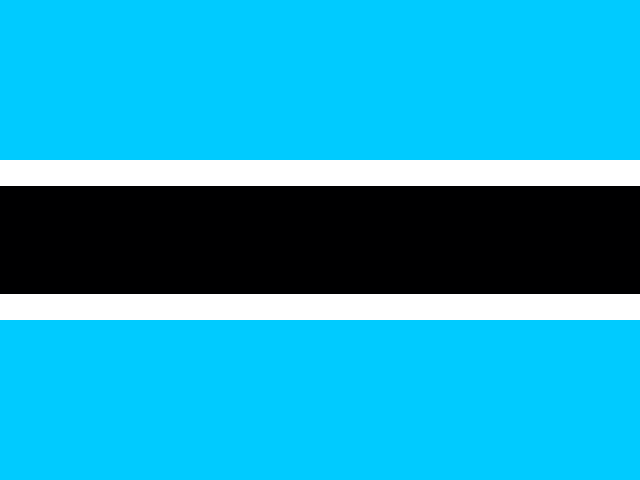
The flag of Botswana consists of a light blue field with a horizontal black stripe across the center, bordered above and below by thinner white stripes. The proportion is 2:3. It was adopted on 30 September 1966, when Botswana gained independence from Britain, and has remained unchanged since.
Colors and meaning
Light blue represents water — a precious resource in Botswana's semi-arid climate — and the sky, and comes from the national motto 'Pula', which means 'rain'. Black and white represent the racial harmony and equality of the Black and white populations of Botswana, and were also inspired by the markings of the zebra, the national animal.
Light blue
Represents water — a precious resource in Botswana, which is largely covered by the Kalahari Desert — and the sky. The color is drawn from the national motto 'Pula', which means 'rain' in Setswana and is also the name of the national currency.
Black
Represents the Black African majority of Botswana and, together with the white stripe, symbolizes racial harmony and equality among all the peoples of Botswana.
White
Represents the white minority population of Botswana and peace. The black and white stripes together symbolize the peaceful coexistence of different races, in contrast to the racial segregation policies of neighboring South Africa and Rhodesia at the time of Botswana's independence.
Zebra inspiration
The black and white stripes are also inspired by the zebra, the national animal of Botswana. Zebras are common in Botswana's national parks, particularly the Okavango Delta and Chobe National Park.
History and adoption
Botswana was a British protectorate known as Bechuanaland from 1885 until 1966. The flag was designed in 1966, in preparation for independence, and was adopted on 30 September 1966, when Botswana became an independent republic within the Commonwealth. The design was chosen to be distinct from the flags of neighboring countries — South Africa and Rhodesia both used flags with racial symbolism at the time — and to emphasize Botswana's commitment to racial harmony and peaceful development. The flag has remained unchanged since independence.
Key facts
- Adopted
- 30 September 1966
- Proportion
- 2:3
- Designer
- George Winstanley
- Capital
- Gaborone
- Country code
- BW
- Similar flags
- None
Historical and related flags
Botswana used several flags during its colonial period before independence.
- Bechuanaland Protectorate (1885–1966): British Blue Ensign with a colonial badge.
- Current flag (1966–present): Light blue field with a black stripe edged in white.
- Presidential standard: Uses the Botswana coat of arms on a light blue field.
Frequently asked questions
What does the flag of Botswana look like?
The flag of Botswana is a light blue field with a horizontal black stripe through the center, edged in white. The proportion is 2:3.
When was the flag of Botswana adopted?
The current flag of Botswana was officially adopted on 30 September 1966.
What do the colors mean?
Light blue represents water — a precious resource in Botswana's semi-arid climate — and the sky, and comes from the national motto 'Pula', which means 'rain'. Black and white represent the racial harmony and equality of the Black and white populations of Botswana, and were also inspired by the markings of the zebra, the national animal.
Which flags look similar to the Botswana flag?
No other national flag closely resembles Botswana's. The light blue field with a black stripe edged in white is unique among national flags.

 Namibia
 South Africa
 Zimbabwe
 Zambia
 Lesotho
 Eswatini