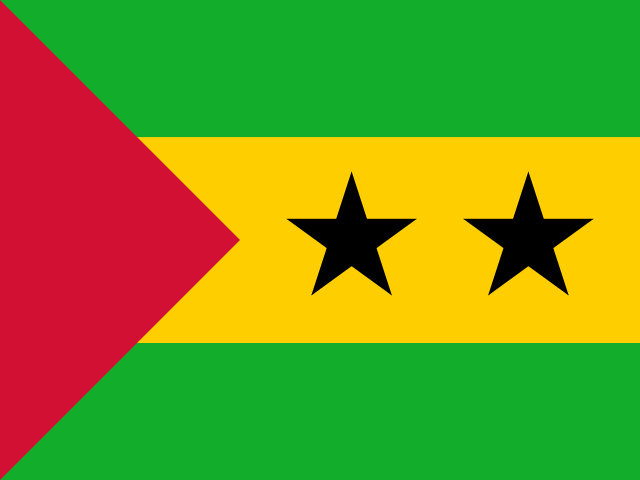
What the flag looks like
The flag of São Tomé and Príncipe consists of three horizontal bands of green (top), yellow (center) and green (bottom). The yellow band is wider than the two green bands. A red isosceles triangle at the hoist contains two black five-pointed stars. The proportion is 1:2. It was adopted on 12 July 1975, when the country gained independence from Portugal.
Colors and meaning
Green represents the lush vegetation and forests of the two islands, yellow represents the sun, cocoa — the country's main export — and the equatorial heat, red represents the blood shed in the struggle for independence, and the two black stars represent the two main islands of the archipelago, São Tomé and Príncipe.
Green
Represents the lush tropical vegetation and forests of the two volcanic islands of São Tomé and Príncipe, located in the Gulf of Guinea off the coast of Central Africa.
Yellow
Represents the sun and the equatorial heat, and cocoa — São Tomé and Príncipe was once the world's largest cocoa producer, and the crop still dominates its economy.
Red triangle
Represents the blood shed by São Toméan patriots in the struggle for independence from Portugal, achieved in 1975, and the country's revolutionary heritage.
Two black stars
Represent the two main islands of the archipelago, São Tomé and Príncipe, and the unity of the two-island nation. The stars are placed side by side within the red triangle, symbolizing the equal partnership of the two islands.
Design origin
The flag was designed by the Movement for the Liberation of São Tomé and Príncipe (MLSTP) during the independence struggle and is based on the flag of the PAIGC, which used similar Pan-African colors and layout.
History and adoption
São Tomé and Príncipe was a Portuguese colony from 1493 until 1975, when it gained independence on 12 July 1975 following the Carnation Revolution in Portugal. The flag was adopted on independence day and has remained unchanged since, despite the country's political changes — including a period of one-party rule under the MLSTP and the transition to multi-party democracy in 1991.
Key facts
- Adopted
- 12 July 1975
- Proportion
- 1:2
- Designer
- MLSTP (independence movement)
- Capital
- São Tomé
- Country code
- ST
- Similar flags
- None
Historical and related flags
São Tomé and Príncipe used several flags during its colonial period before independence.
- Portuguese São Tomé and Príncipe (1493–1975): Portuguese flag used during colonial rule.
- MLSTP flag (1960s–1975): Same design used during liberation struggle.
- Current flag (1975–present): Green-yellow-green with red triangle and two black stars.
- Presidential standard: Uses the São Toméan coat of arms on a green field.
Frequently asked questions
What does the flag of São Tomé and Príncipe look like?
The flag of São Tomé and Príncipe has three horizontal bands of green (top), yellow (center, wider) and green (bottom), with a red isosceles triangle at the hoist bearing two black five-pointed stars. The proportion is 1:2.
When was the flag of São Tomé and Príncipe adopted?
The current flag of São Tomé and Príncipe was officially adopted on 12 July 1975.
What do the colors mean?
Green represents the lush vegetation and forests of the two islands, yellow represents the sun, cocoa — the country's main export — and the equatorial heat, red represents the blood shed in the struggle for independence, and the two black stars represent the two main islands of the archipelago, São Tomé and Príncipe.
Which flags look similar to the São Tomé and Príncipe flag?
No other national flag closely resembles São Tomé and Príncipe's. The combination of green-yellow-green bands with a red hoist triangle and two black stars is unique.

 Cape Verde
 Guinea-Bissau
 Gabon
 Equatorial Guinea
 Angola
 Portugal