What the flag looks like
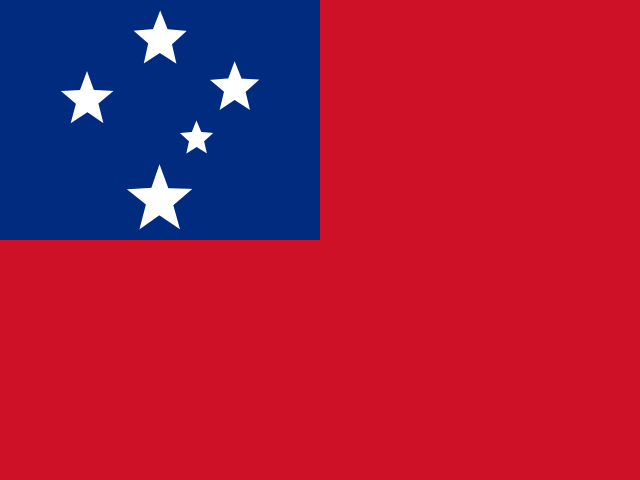
The Samoan flag consists of a red field with a blue rectangle in the upper hoist canton bearing five white five-pointed stars that represent the Southern Cross constellation. The proportion is 1:2. It was adopted on 24 February 1949, when Samoa was a United Nations trust territory administered by New Zealand, and was retained when Samoa became the first Pacific island nation to gain independence, on 1 January 1962.
Colors and meaning
Red represents courage, sacrifice and the blood shed for Samoan independence, blue represents freedom and the Pacific Ocean that surrounds the islands, and the five white stars of the Southern Cross represent Samoa's location in the Southern Hemisphere and its identity as a Pacific nation.
Red field
Represents courage, sacrifice and the blood shed by Samoan patriots in the long struggle for independence, particularly during the Mau movement against colonial rule in the early 20th century. Red is also a traditional color of Samoan chiefly dress and ritual.
Blue canton
Represents freedom, loyalty and the Pacific Ocean that surrounds the Samoan islands. Blue also represents the sky over the archipelago.
Southern Cross
The five white stars represent the Southern Cross constellation — Crux — which is prominently visible from Samoa's location in the South Pacific. The stars are Alpha, Beta, Gamma, Delta and Epsilon Crucis. The Southern Cross has been a symbol of Pacific and Southern Hemisphere identity since the 19th century and appears on several flags of the region.
Design origin
The design was based on the flag used by the Samoan independence movement, which combined the traditional Samoan red and the Southern Cross. The flag was formally adopted on 24 February 1949, when Samoa was a UN trust territory administered by New Zealand, and was retained at independence on 1 January 1962.
History and adoption
Samoa was a German colony from 1900 until 1914, when it was occupied by New Zealand during World War I, and then administered by New Zealand as a League of Nations mandate and later a United Nations trust territory. During the 1920s and 1930s, the Mau movement led nonviolent resistance to colonial rule, and its flag was a red field with a blue canton bearing the Southern Cross. This flag was adopted on 24 February 1949 and was retained when Samoa became the first Pacific island nation to gain independence, on 1 January 1962. Samoa was also the first Polynesian nation to gain independence in the 20th century. The flag has remained unchanged since.
Key facts
- Adopted
- 24 February 1949
- Proportion
- 1:2
- Designer
- Based on the flag used by the Mau independence movement
- Capital
- Apia
- Country code
- WS
- Similar flags
- New Zealand, Australia, Papua New Guinea
Historical and related flags
Samoa has used several flags across its German, New Zealand and independence periods.
- German Samoa (1900–1914): German colonial flags.
- New Zealand administration (1914–1949): New Zealand flag used during administration.
- Mau movement flag (1920s–1949): Red field with the Southern Cross and the word 'Samoa'.
- Current flag (1949–present): Red field with blue canton and five white stars.
- Head of State standard: Uses the Samoan coat of arms on a red field.
Frequently asked questions
What does the flag of Samoa look like?
The flag of Samoa is a red field with a blue rectangle in the upper hoist canton bearing five white five-pointed stars representing the Southern Cross constellation. The proportion is 1:2.
When was the flag of Samoa adopted?
The current flag of Samoa was officially adopted on 24 February 1949.
What do the colors mean?
Red represents courage, sacrifice and the blood shed for Samoan independence, blue represents freedom and the Pacific Ocean that surrounds the islands, and the five white stars of the Southern Cross represent Samoa's location in the Southern Hemisphere and its identity as a Pacific nation.
Which flags look similar to the Samoa flag?
New Zealand and Australia use blue fields with the Union Jack and the Southern Cross. Papua New Guinea uses a black and red diagonal with the Southern Cross. Samoa's red field with a blue canton bearing the Southern Cross is distinct from all of them.

 Tonga
 New Zealand
 Australia
 Fiji
 Papua New Guinea
 Tuvalu