What the flag looks like
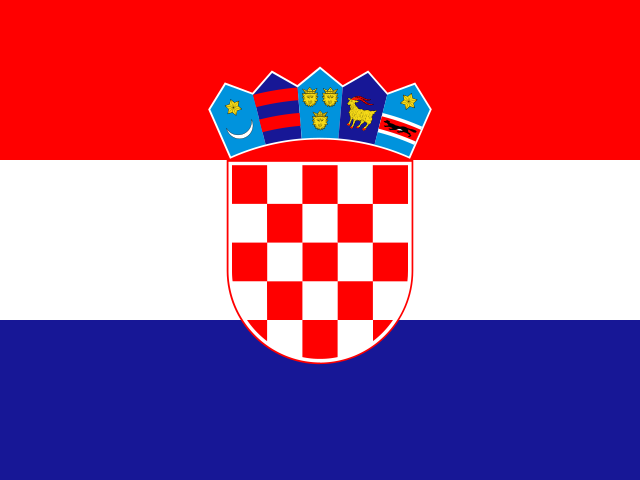
The Croatian flag consists of three equal horizontal bands of red (top), white (middle) and blue (bottom), with the Croatian coat of arms in the center. The coat of arms is a red-and-white checkerboard shield topped by a crown of five smaller shields representing historical Croatian regions. The proportion is 1:2.
Colors and meaning
Red, white and blue are the Pan-Slavic colors adopted by Croatia in the 19th century during the Illyrian movement, and they appear on the historical flags of the Kingdom of Croatia, Slavonia and Dalmatia. The checkerboard shield, known as the šahovnica, is the oldest Croatian national symbol.
Red
Represents the blood shed for Croatian independence and is one of the three Pan-Slavic colors. It also appears on the historical flag of the Kingdom of Croatia.
White
Represents peace, purity and honesty. In the checkerboard coat of arms, white and red alternate in a 5x5 pattern.
Blue
Represents loyalty, justice and the Adriatic Sea. It is one of the Pan-Slavic colors, adopted during the 19th-century Illyrian movement.
Šahovnica
The red-and-white checkerboard shield is Croatia's oldest national symbol, first appearing in the 10th century and traditionally associated with King Stjepan Držislav. It has been used continuously ever since.
Five small shields
The crown above the main shield represents five historical Croatian regions: Croatia proper, Dubrovnik, Dalmatia, Istria and Slavonia.
History and adoption
The red-white-blue tricolor was first used as a Croatian national symbol during the Illyrian movement in the 1830s, inspired by Pan-Slavic colors. It was officially adopted by the Kingdom of Croatia in 1848 and used until 1918, when Croatia joined the Kingdom of Serbs, Croats and Slovenes. During the Yugoslav period (1918–1991), Croatia used the Yugoslav flag with a red star, though the tricolor was retained for some official uses. On 21 December 1990, shortly before Croatia declared independence from Yugoslavia, the current design was adopted — the tricolor with the checkerboard shield and the five-region crown, without the communist star.
Key facts
- Adopted
- 21 December 1990
- Proportion
- 1:2
- Designer
- Miroslav Šutej (current design)
- Capital
- Zagreb
- Country code
- HR
- Similar flags
- Serbia, Slovakia, Slovenia
Historical and related flags
Croatia has used several national flags across its Habsburg, Yugoslav and modern periods.
- Kingdom of Croatia (1848–1918): Red-white-blue tricolor with the Croatian coat of arms.
- Banovina of Croatia (1939–1941): Tricolor with the checkerboard shield.
- Independent State of Croatia (1941–1945): Tricolor with a large checkerboard shield and Ustasha emblem.
- SR Croatia (1945–1990): Yugoslav tricolor with a red star and a small Croatian shield.
- Current flag (1990–present): Tricolor with the modern checkerboard shield and five-region crown.
Frequently asked questions
What does the flag of Croatia look like?
The flag of Croatia has three equal horizontal bands of red (top), white (middle) and blue (bottom), with the Croatian coat of arms in the center. The proportion is 1:2.
When was the flag of Croatia adopted?
The current flag of Croatia was officially adopted on 21 December 1990.
What do the colors mean?
Red, white and blue are the Pan-Slavic colors adopted by Croatia in the 19th century during the Illyrian movement, and they appear on the historical flags of the Kingdom of Croatia, Slavonia and Dalmatia. The checkerboard shield, known as the šahovnica, is the oldest Croatian national symbol.
Which flags look similar to the Croatia flag?
Serbia, Slovakia and Slovenia all use the same red-white-blue horizontal tricolor with different coats of arms in the center. Croatia's checkerboard shield is unique among them.

 Serbia
 Slovakia
 Slovenia
 Bosnia and Herzegovina
 Montenegro
 Hungary