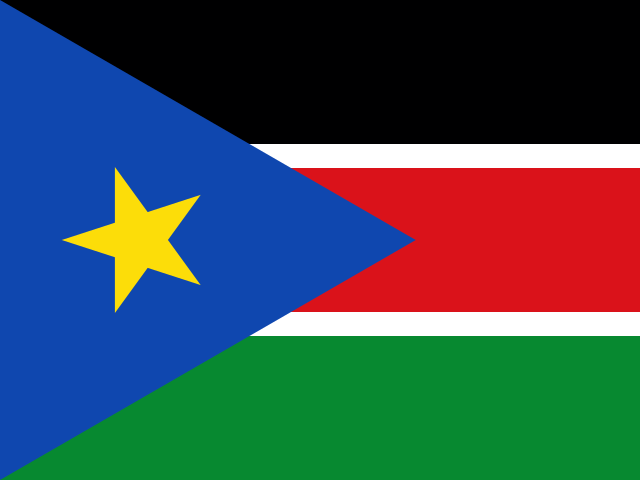
What the flag looks like
The South Sudanese flag consists of three horizontal bands of black (top), red (middle) and green (bottom), separated by thin white stripes. A blue isosceles triangle at the hoist contains a gold five-pointed star. The proportion is 1:2. It was adopted on 9 July 2005, when South Sudan became an autonomous region, and became the national flag on 9 July 2011, when the country gained independence from Sudan.
Colors and meaning
Black represents the Black African people of South Sudan, red represents the blood shed for freedom, green represents the land and agriculture, white represents peace, blue represents the Nile River, and the gold star represents unity and hope for the future.
Black
Represents the Black African people of South Sudan and their identity, heritage and dignity.
Red
Represents the blood shed by South Sudanese patriots during the long struggle for freedom, including the two Sudanese civil wars (1955–1972 and 1983–2005).
Green
Represents the fertile land, agriculture and natural wealth of South Sudan, and hope for the future.
White
Represents peace and the desire for peaceful coexistence after decades of conflict. The white stripes separate the three main colors.
Blue
Represents the Nile River, the lifeblood of South Sudan and the source of water for the country's people and agriculture.
Gold star
Represents the unity of the many ethnic groups of South Sudan and the guiding light of the new nation. It is the Star of Bethlehem, symbolizing hope and guidance.
History and adoption
South Sudan's flag was designed by Samuel Ajak, a former child soldier, in the 1990s during the Second Sudanese Civil War. It was used by the Sudan People's Liberation Movement (SPLM) as its banner during the conflict. On 9 July 2005, when the Comprehensive Peace Agreement created the autonomous Government of Southern Sudan, the flag was adopted as the regional flag. After a referendum in January 2011, South Sudan declared independence on 9 July 2011, and the flag became the national flag of the world's newest country. The design has remained unchanged since.
Key facts
- Adopted
- 9 July 2011
- Proportion
- 1:2
- Designer
- Samuel Ajak
- Capital
- Juba
- Country code
- SS
- Similar flags
- Kenya, Palestine, Kuwait
Historical and related flags
South Sudan used several flags during its long struggle for independence.
- Anyanya rebellion (1955–1972): Various rebel flags used during the First Sudanese Civil War.
- SPLM flag (1983–2005): Current design used by the Sudan People's Liberation Movement.
- Autonomous region (2005–2011): Flag used by the Government of Southern Sudan.
- Current flag (2011–present): National flag of the Republic of South Sudan.
Frequently asked questions
What does the flag of South Sudan look like?
The flag of South Sudan has three horizontal bands of black, red and green separated by thin white stripes, with a blue triangle at the hoist bearing a gold five-pointed star. The proportion is 1:2.
When was the flag of South Sudan adopted?
The current flag of South Sudan was officially adopted on 9 July 2011.
What do the colors mean?
Black represents the Black African people of South Sudan, red represents the blood shed for freedom, green represents the land and agriculture, white represents peace, blue represents the Nile River, and the gold star represents unity and hope for the future.
Which flags look similar to the South Sudan flag?
Kenya uses black-red-green with a Maasai shield. Palestine uses black-white-green with a red triangle. South Sudan combines the color palette of Kenya with the hoist triangle of Palestine, making it visually distinct.

 Sudan
 Kenya
 Ethiopia
 Uganda
 Palestine
 Egypt