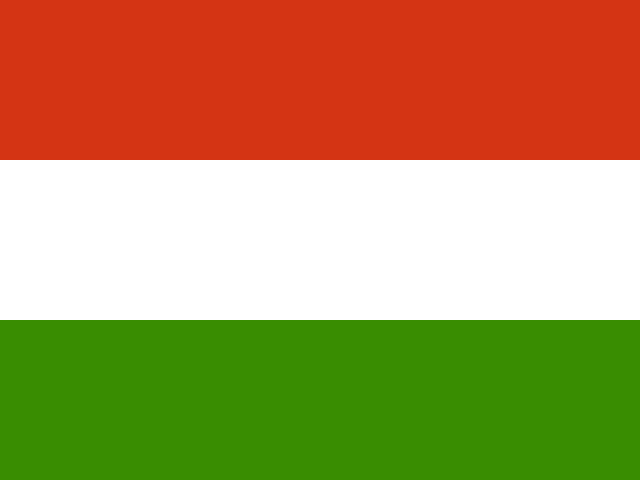
What the flag looks like
The Hungarian flag consists of three equal horizontal bands of red (top), white (middle) and green (bottom). The proportion is 2:3. The current design was adopted on 23 May 1957, after the failure of the 1956 Hungarian Revolution, but the tricolor itself dates back to the 1848 revolution.
Colors and meaning
Red represents strength, bravery and the blood shed for Hungarian independence, white represents faithfulness, purity and hope, and green represents the hope for a better future and the country's fertile land. The colors derive from the medieval coat of arms of Hungary, which features a red-and-white striped field and a green triple hill.
Red
Represents strength, bravery and the blood shed for Hungarian independence, particularly in the 1848 and 1956 revolutions.
White
Represents faithfulness, purity, hope and the white stripes of the Árpád dynasty coat of arms.
Green
Represents hope for the future and Hungary's fertile land. Green is also the color of the triple hill in the Hungarian coat of arms.
Origin
The red-white-green combination derives from the medieval coat of arms of Hungary, which was used by the Árpád dynasty and later by the Kingdom of Hungary. The colors became a national tricolor during the 1848 revolution against the Habsburg Empire.
History and adoption
The red-white-green tricolor was first used during the Hungarian Revolution of 1848 against the Habsburg Empire, inspired by the French Tricolore. After the revolution was crushed in 1849, the flag was banned by Austrian authorities. It was restored when the Austro-Hungarian Compromise of 1867 created the dual monarchy. Under communist rule (1949–1956), the flag was modified with the Rákosi coat of arms in the center — a symbol so hated that protesters in 1956 tore it out, leaving a distinctive hole in the middle. After the Soviet invasion crushed the revolution, the current plain tricolor was adopted on 23 May 1957, and has remained unchanged since.
Key facts
- Adopted
- 23 May 1957
- Proportion
- 2:3
- Designer
- Traditional — based on medieval Hungarian heraldry
- Capital
- Budapest
- Country code
- HU
- Similar flags
- Italy, Bulgaria, Iran
Historical and related flags
Hungary has used several national flags across its medieval, Habsburg, communist and post-communist periods.
- Kingdom of Hungary (medieval): Red-and-white striped banners with the Árpád coat of arms.
- Hungarian Revolution (1848–1849): First use of the red-white-green tricolor.
- Austria-Hungary (1867–1918): Hungarian tricolor used alongside the Austrian flag.
- Hungarian People's Republic (1949–1956): Tricolor with the Rákosi coat of arms in the center.
- 1956 Revolution: Protesters cut the communist emblem out of the flag.
- Current flag (1957–present): Plain red-white-green tricolor.
Frequently asked questions
What does the flag of Hungary look like?
The flag of Hungary has three equal horizontal bands of red (top), white (middle) and green (bottom). The proportion is 2:3.
When was the flag of Hungary adopted?
The current flag of Hungary was officially adopted on 23 May 1957.
What do the colors mean?
Red represents strength, bravery and the blood shed for Hungarian independence, white represents faithfulness, purity and hope, and green represents the hope for a better future and the country's fertile land. The colors derive from the medieval coat of arms of Hungary, which features a red-and-white striped field and a green triple hill.
Which flags look similar to the Hungary flag?
Italy uses green-white-red vertical bands. Bulgaria uses white-green-red horizontal bands. Iran uses green-white-red horizontal bands with a central emblem. Hungary's red-white-green horizontal tricolor is unique in Europe.

 Austria
 Italy
 Bulgaria
 Slovakia
 Romania
 Croatia