What the flag looks like
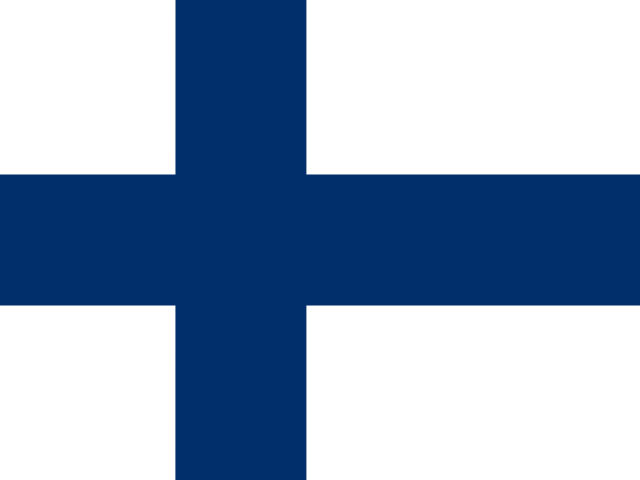
The Finnish flag consists of a white field bearing a blue Nordic cross, with the vertical bar offset toward the hoist. The proportion is 11:18. It was adopted on 29 May 1918, following Finland's declaration of independence from Russia in December 1917, and has remained unchanged since.
Colors and meaning
Blue represents Finland's thousands of lakes and its skies, and white represents the snow that covers the country in winter. The Nordic cross design reflects Finland's cultural and historical ties to Scandinavia.
Blue
Represents Finland's 188,000 lakes and the clear Nordic sky. Blue has been a Finnish national color since the 19th century.
White
Represents the snow that covers Finland for much of the year, and purity and peace.
Nordic cross
The cross design is shared with Denmark, Sweden, Norway and Iceland, representing Christianity and Nordic unity. Finland adopted the design after gaining independence to emphasize its Scandinavian identity.
History and adoption
The Finnish flag was adopted on 29 May 1918, six months after Finland declared independence from Russia. The blue-and-white color combination had been used by Finnish yacht clubs and nationalist groups since the 1860s, when Finland was still a grand duchy within the Russian Empire. Multiple designs were proposed after independence, including one with a red field and yellow cross. The final design — a blue cross on white — was chosen by the Finnish parliament after a design competition. The proportions were standardized in 1918 and have not changed since.
Key facts
- Adopted
- 29 May 1918
- Proportion
- 11:18
- Designer
- Bruno Granholm (design), Eero Snellman (final version)
- Capital
- Helsinki
- Country code
- FI
- Similar flags
- Sweden, Denmark, Norway, Iceland
Historical and related flags
Finland has used several flags across its time as a Swedish and Russian territory, and today uses several official variants.
- Swedish rule (pre-1809): Swedish flag used.
- Grand Duchy of Finland (1809–1917): Russian flag used, with Finnish arms on some official variants.
- Finnish yacht club flag (1860s–1917): Blue cross on white, precursor to the national flag.
- National flag (1918–present): Blue cross on white, adopted at independence.
- State flag: Square version with the Finnish coat of arms in the center.
- War flag and naval ensign: Swallow-tailed version used by the military.
Frequently asked questions
What does the flag of Finland look like?
The flag of Finland is a white field with a blue Nordic cross that extends to the edges of the flag. The proportion is 11:18.
When was the flag of Finland adopted?
The current flag of Finland was officially adopted on 29 May 1918.
What do the colors mean?
Blue represents Finland's thousands of lakes and its skies, and white represents the snow that covers the country in winter. The Nordic cross design reflects Finland's cultural and historical ties to Scandinavia.
Which flags look similar to the Finland flag?
Denmark uses a red field with a white cross, Sweden uses blue with yellow, Norway uses red with a blue-and-white cross, and Iceland uses blue with a red-and-white cross. Finland's blue cross on white is unique among them.

 Sweden
 Denmark
 Norway
 Iceland
 Estonia
 Russia