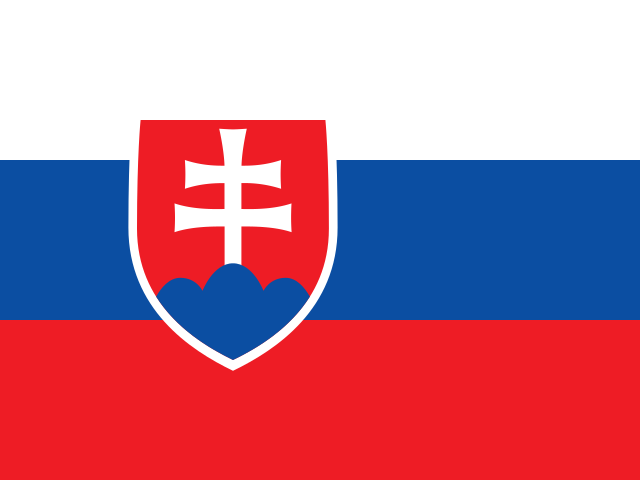
What the flag looks like
The Slovak flag consists of three equal horizontal bands of white (top), blue (middle) and red (bottom), with the Slovak coat of arms positioned toward the hoist side and centered vertically. The coat of arms is a red shield with a white double cross standing on three blue hills. The proportion is 2:3.
Colors and meaning
White, blue and red are the Pan-Slavic colors adopted by Slovak nationalists in the 19th century. White represents peace and purity, blue represents the sky and Slovakia's rivers, and red represents the blood shed for Slovak independence. The double cross is a Christian symbol associated with the Byzantine mission of Saints Cyril and Methodius, who brought Christianity to the Slavs in the 9th century.
White
Represents peace, purity and honesty. It is the top band and the color of the double cross on the coat of arms.
Blue
Represents the sky, the Tatra mountains and Slovakia's rivers. It is one of the three Pan-Slavic colors.
Red
Represents the blood shed for Slovak independence and the field color of the Slovak coat of arms.
Double cross
A patriarchal cross with two horizontal arms, associated with the Byzantine mission of Saints Cyril and Methodius, who brought Christianity to the Slavs in 863. It is also the symbol of the Hungarian kings of the Árpád dynasty.
Three hills
Represent the Tatra, Fatra and Matra mountain ranges, symbolizing the Slovak and Hungarian lands where the double cross has historically appeared.
History and adoption
The white-blue-red tricolor was first used by Slovak nationalists during the 1848 revolution against the Hungarian part of the Habsburg Empire. It was used intermittently through the 19th and early 20th centuries and briefly by the Slovak Soviet Republic in 1919. During the Czechoslovak period (1918–1938), Slovakia used the Czechoslovak flag. The First Slovak Republic (1939–1945) used a similar tricolor with the coat of arms. After the fall of communism and the approaching dissolution of Czechoslovakia, Slovakia adopted the current flag on 3 September 1992, shortly before declaring independence on 1 January 1993. The coat of arms was designed by Ladislav Čisárik and Ladislav Vrtel.
Key facts
- Adopted
- 3 September 1992
- Proportion
- 2:3
- Designer
- Ladislav Čisárik, Ladislav Vrtel (coat of arms)
- Capital
- Bratislava
- Country code
- SK
- Similar flags
- Slovenia, Serbia, Russia
Historical and related flags
Slovakia has used several flags across its Habsburg, Czechoslovak, wartime and modern periods.
- Slovak National Council (1848–1849): First white-blue-red tricolor used by Slovak nationalists.
- Slovak Soviet Republic (1919): Red flag used briefly.
- First Slovak Republic (1939–1945): White-blue-red tricolor with the double-cross coat of arms.
- Czechoslovakia (1918–1992): Czechoslovak flag used on Slovak territory.
- Slovak Socialist Republic (1960–1990): Czechoslovak flag with a Slovak emblem in some uses.
- Current flag (1992–present): White-blue-red tricolor with the Slovak coat of arms.
Frequently asked questions
What does the flag of Slovakia look like?
The flag of Slovakia has three equal horizontal bands of white (top), blue (middle) and red (bottom), with the Slovak coat of arms shifted toward the hoist. The proportion is 2:3.
When was the flag of Slovakia adopted?
The current flag of Slovakia was officially adopted on 3 September 1992.
What do the colors mean?
White, blue and red are the Pan-Slavic colors adopted by Slovak nationalists in the 19th century. White represents peace and purity, blue represents the sky and Slovakia's rivers, and red represents the blood shed for Slovak independence. The double cross is a Christian symbol associated with the Byzantine mission of Saints Cyril and Methodius, who brought Christianity to the Slavs in the 9th century.
Which flags look similar to the Slovakia flag?
Slovenia uses white-blue-red with Mount Triglav. Serbia uses red-blue-white with a double-headed eagle. Russia uses white-blue-red without any emblem. Slovakia's double cross on three hills distinguishes it from all of them.

 Czechia
 Slovenia
 Serbia
 Hungary
 Poland
 Austria