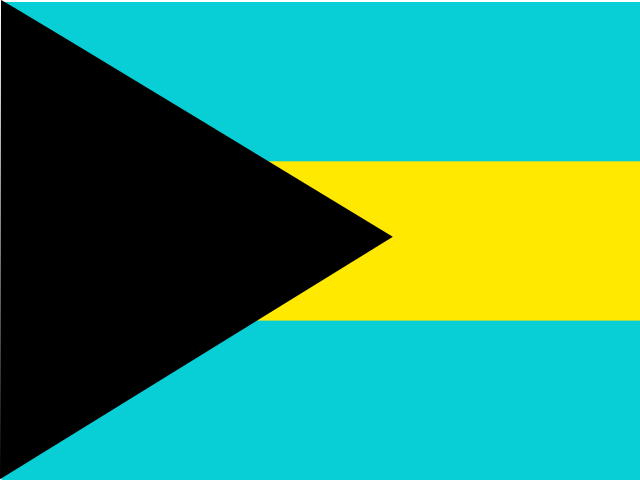
What the flag looks like
The Bahamian flag consists of three horizontal bands — aquamarine at the top and bottom, and a wider gold band in the center — with a black equilateral triangle at the hoist pointing toward the fly. The proportion is 1:2. It was adopted on 10 July 1973, when the Bahamas gained independence from Britain.
Colors and meaning
The aquamarine bands represent the Caribbean Sea surrounding the Bahamas, the gold band represents the golden sand of the Bahamian beaches and the sun, and the black triangle represents the strength, vigor and force of the Bahamian people.
Aquamarine bands
Represent the crystal-clear Caribbean Sea that surrounds the Bahamas archipelago — over 700 islands and 2,000 cays spread across 250,000 square kilometers of ocean. The turquoise-aquamarine color is one of the most distinctive national flag colors in the world and reflects the shallow tropical waters surrounding the islands.
Gold band
Represents the golden sand of the Bahamian beaches and the warm sun that shines on the islands year-round. The wider gold band also represents the country's bright future and the wealth of its natural environment.
Black triangle
Represents the strength, vigor and force of the Bahamian people — the descendants of African slaves, British Loyalists and other settlers who came to the islands. The triangle points toward the fly, symbolizing the country's forward movement and progress. Black is a color of unity and determination.
Design origin
The flag was designed by Dr. Hervis Bain, a Bahamian artist, in a competition held in preparation for independence. It was adopted on 10 July 1973, the day the Bahamas gained independence from Britain. The design was chosen to represent the three most important elements of Bahamian identity: the sea, the sand and the people.
History and adoption
The Bahamas was a British colony from 1718 until 1973, when it gained independence on 10 July 1973 as a Commonwealth realm with Queen Elizabeth II as head of state. The flag was designed by Dr. Hervis Bain in a national competition held in preparation for independence. It was adopted on independence day and has remained unchanged since, including through the country's development as a major tourism and financial services destination.
Key facts
- Adopted
- 10 July 1973
- Proportion
- 1:2
- Designer
- Dr. Hervis Bain
- Capital
- Nassau
- Country code
- BS
- Similar flags
- None
Historical and related flags
The Bahamas used several flags during its British colonial period before independence.
- British Bahamas (1718–1964): British Blue Ensign with a colonial badge.
- British Bahamas (1964–1973): Blue Ensign with an updated colonial badge featuring a ship and a palm tree.
- Current flag (1973–present): Aquamarine and gold bands with a black hoist triangle.
- Governor-General's standard: Uses the Bahamian coat of arms with a flamingo and a marlin.
- Naval ensign: White ensign with the Bahamian flag in the canton and a red emblem on the fly.
Frequently asked questions
What does the flag of Bahamas look like?
The flag of the Bahamas has three horizontal bands of aquamarine (top), gold (center, wider) and aquamarine (bottom), with a black equilateral triangle at the hoist. The proportion is 1:2.
When was the flag of Bahamas adopted?
The current flag of Bahamas was officially adopted on 10 July 1973.
What do the colors mean?
The aquamarine bands represent the Caribbean Sea surrounding the Bahamas, the gold band represents the golden sand of the Bahamian beaches and the sun, and the black triangle represents the strength, vigor and force of the Bahamian people.
Which flags look similar to the Bahamas flag?
No other national flag closely resembles the Bahamas'. The combination of aquamarine and gold bands with a black hoist triangle is unique.

 Jamaica
 Cuba
 Haiti
 Trinidad and Tobago
 Barbados
 United States