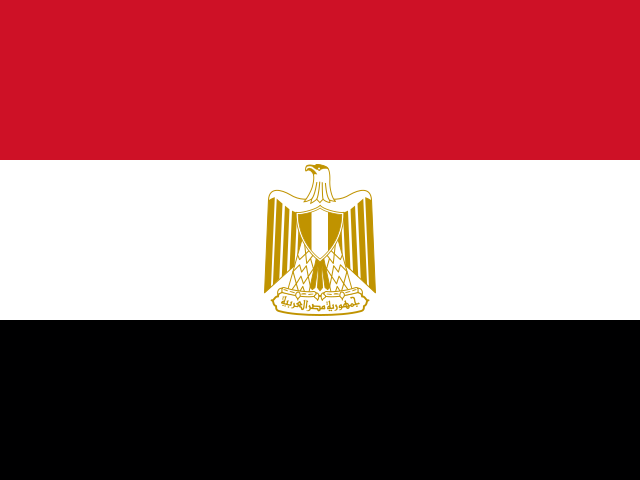
What the flag looks like
The Egyptian flag consists of three equal horizontal bands of red (top), white (middle) and black (bottom), with the golden Eagle of Saladin centered on the white band. The eagle faces the hoist and bears a shield on its chest. The proportion is 2:3. It was adopted on 4 October 1984 and has remained unchanged since.
Colors and meaning
Red represents the blood shed by Egyptian patriots in the struggle against colonial rule, white represents peace and purity, and black represents the end of oppression and the dark years under foreign rule. The Eagle of Saladin represents strength, courage and Egypt's Arab and Islamic heritage.
Red
Represents the blood shed by Egyptian patriots in the struggle against British colonial rule and the 1952 revolution that overthrew the monarchy. Red is a traditional color of Arab nationalist movements.
White
Represents peace, purity and a bright future. It is the middle band and the background for the Eagle of Saladin.
Black
Represents the end of oppression, the dark years of foreign rule and the determination of the Egyptian people. Black is a historic color of Arab and Islamic banners.
Eagle of Saladin
The golden eagle with a shield on its chest is the Eagle of Saladin, named after the 12th-century Muslim leader who united Egypt and Syria. It represents strength, courage and Arab unity, and is also used on the flags of Iraq, Syria and Yemen.
History and adoption
Egypt has used several flags since the 19th century. The current tricolor of red, white and black was first adopted in 1952, when the Free Officers Movement overthrew the monarchy. It was used by the Republic of Egypt (1953–1958). From 1958 to 1961, Egypt and Syria formed the United Arab Republic and used a flag with two green stars in the white band. From 1972 to 1984, Egypt used a flag with the Golden Hawk of Quraish in the center. The current flag, with the Eagle of Saladin, was adopted on 4 October 1984 and has remained unchanged since.
Key facts
- Adopted
- 4 October 1984
- Proportion
- 2:3
- Designer
- Based on the 1952 Arab Liberation Flag
- Capital
- Cairo
- Country code
- EG
- Similar flags
- Iraq, Syria, Yemen
Historical and related flags
Egypt has used several flags across its monarchic, republican and Arab-unity periods.
- Muhammad Ali dynasty (1805–1922): Red flag with three white crescents and stars.
- Kingdom of Egypt (1922–1953): Green flag with a white crescent and three stars.
- Republic of Egypt (1953–1958): Red-white-black tricolor with the Eagle of Saladin.
- United Arab Republic (1958–1971): Tricolor with two green stars.
- Federation of Arab Republics (1972–1984): Tricolor with the Golden Hawk of Quraish.
- Current flag (1984–present): Tricolor with the Eagle of Saladin restored.
Frequently asked questions
What does the flag of Egypt look like?
The flag of Egypt has three equal horizontal bands of red (top), white (middle) and black (bottom), with the golden Eagle of Saladin in the center of the white band. The proportion is 2:3.
When was the flag of Egypt adopted?
The current flag of Egypt was officially adopted on 4 October 1984.
What do the colors mean?
Red represents the blood shed by Egyptian patriots in the struggle against colonial rule, white represents peace and purity, and black represents the end of oppression and the dark years under foreign rule. The Eagle of Saladin represents strength, courage and Egypt's Arab and Islamic heritage.
Which flags look similar to the Egypt flag?
Iraq, Syria and Yemen use the same red-white-black tricolor with different emblems in the white band. Iraq uses the Takbir in green, Syria uses two green stars, and Yemen uses no emblem. Egypt's Eagle of Saladin is unique among them.

 Iraq
 Syria
 Yemen
 Libya
 Sudan
 Saudi Arabia