What the flag looks like
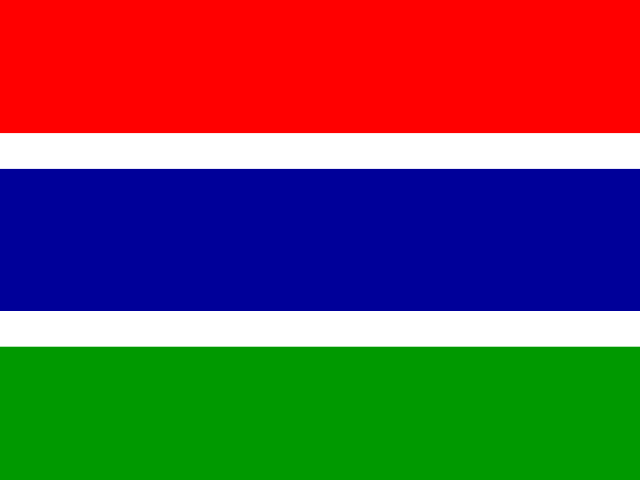
The Gambian flag consists of five horizontal bands: red on top (one-third of the height), a thin white stripe, blue in the center (one-third), a thin white stripe, and green at the bottom (one-third). The proportion is 2:3. It was adopted on 18 February 1965, when Gambia gained independence from Britain.
Colors and meaning
Red represents the sun and the savanna grasslands of Gambia, blue represents the Gambia River that runs through the center of the country, green represents the forests and agricultural land, and the thin white stripes represent peace and unity. The design mirrors the geography of Gambia — the river flanked by savanna and forest.
Red
Represents the sun and the savanna grasslands that cover much of Gambia, particularly the northern and southern regions away from the river.
Blue
Represents the Gambia River, which flows through the center of the country from east to west for about 1,130 kilometers before emptying into the Atlantic Ocean. The river is the defining geographic feature of the country — Gambia is a narrow strip of land on either side of the river, surrounded by Senegal on three sides.
Green
Represents the forests and agricultural land of Gambia, particularly the mangrove forests and farmland along the river.
White stripes
Represent peace, unity and the desire for peaceful coexistence. They separate the three main colors and provide contrast.
Design origin
The flag was designed by Louis Thomasi, a Gambian civil servant, and was chosen in a national competition before independence. It was adopted on 18 February 1965, when Gambia gained independence from Britain.
History and adoption
Gambia was a British colony from 1888 until 1965, when it gained independence on 18 February 1965. The flag was designed by Louis Thomasi and adopted on independence day. From 1982 to 1989, Gambia was part of the Senegambia Confederation with Senegal, but the flag was not changed during this period. In 2013, Gambia withdrew from the Commonwealth, and in 2017 it rejoined. In 2017, the country's official name was changed from 'Republic of The Gambia' to 'Islamic Republic of The Gambia' by former President Yahya Jammeh, and then back to 'Republic of The Gambia' by his successor Adama Barrow in 2017. The flag itself has remained unchanged since independence.
Key facts
- Adopted
- 18 February 1965
- Proportion
- 2:3
- Designer
- Louis Thomasi
- Capital
- Banjul
- Country code
- GM
- Similar flags
- None
Historical and related flags
Gambia used several flags during its colonial period before independence.
- British Gambia (1888–1965): British Blue Ensign with a colonial badge featuring an elephant and a palm tree.
- Current flag (1965–present): Red, blue and green bands with white stripes.
- Senegambia Confederation (1982–1989): Both Gambia and Senegal retained their own flags during the confederation.
- Presidential standard: Uses the Gambian coat of arms with two lions and a hoe and axe.
Frequently asked questions
What does the flag of Gambia look like?
The flag of Gambia has five horizontal bands: red (top, one-third), white stripe, blue (center, one-third), white stripe, and green (bottom, one-third). The proportion is 2:3.
When was the flag of Gambia adopted?
The current flag of Gambia was officially adopted on 18 February 1965.
What do the colors mean?
Red represents the sun and the savanna grasslands of Gambia, blue represents the Gambia River that runs through the center of the country, green represents the forests and agricultural land, and the thin white stripes represent peace and unity. The design mirrors the geography of Gambia — the river flanked by savanna and forest.
Which flags look similar to the Gambia flag?
No other national flag closely resembles Gambia's. The combination of red, blue and green bands with thin white stripes is unique.

 Senegal
 Guinea-Bissau
 Guinea
 Sierra Leone
 Liberia
 Mauritania