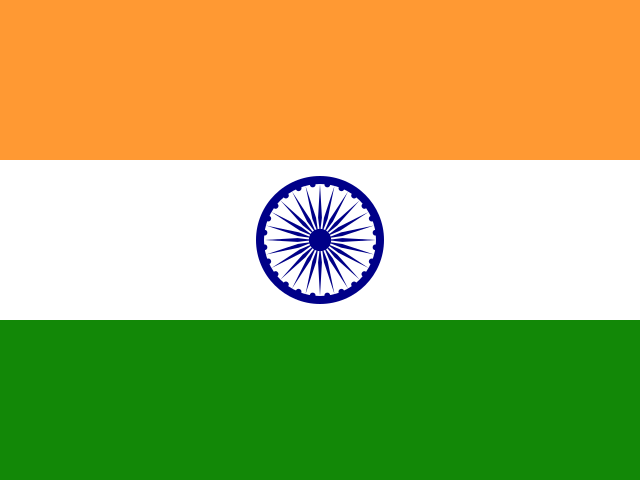
What the flag looks like
The Indian flag consists of three equal horizontal bands of saffron (top), white (middle) and green (bottom), with a navy blue wheel of 24 spokes — the Ashoka Chakra — in the center of the white band. The proportion is 2:3. It was adopted by the Constituent Assembly on 22 July 1947, shortly before India gained independence from Britain.
Colors and meaning
Saffron represents courage, sacrifice and the spirit of renunciation, white represents truth, purity and peace, and green represents faith, fertility and chivalry. The Ashoka Chakra, with its 24 spokes, represents the eternal wheel of law (dharma) and was adapted from the Lion Capital of Ashoka at Sarnath.
Saffron
Represents courage, sacrifice and the spirit of renunciation. It is associated with the Hindu, Buddhist and Sikh traditions of India.
White
Represents truth, purity and peace, and serves as the background for the Ashoka Chakra.
Green
Represents faith, fertility, chivalry and the natural wealth of India.
Ashoka Chakra
A navy blue wheel with 24 spokes, taken from the Lion Capital of Ashoka at Sarnath, built in the 3rd century BCE. It represents the eternal wheel of law (dharma) and the continuous progress of the nation.
History and adoption
The first version of the Indian flag was designed in 1906 by Sachindra Prasad Bose and Sukumar Mitra, with three bands of orange, yellow and green. A second design in 1917 by Bal Gangadhar Tilak introduced the saffron-white-green arrangement with a smaller emblem. In 1921, Pingali Venkayya designed the version with a charkha (spinning wheel) at the center, which was adopted by the Indian National Congress. On 22 July 1947, the Constituent Assembly replaced the charkha with the Ashoka Chakra to symbolize the rule of law and adopted the current design, which has remained unchanged since independence.
Key facts
- Adopted
- 22 July 1947
- Proportion
- 2:3
- Designer
- Pingali Venkayya (design), Badruddin Tyabji (Ashoka Chakra)
- Capital
- New Delhi
- Country code
- IN
- Similar flags
- Niger, Ireland
Historical and related flags
India used several flags during the independence movement before adopting the current national design.
- 1906 Calcutta flag: Orange, yellow and green with Vande Mataram and stars.
- 1907 Berlin flag: Similar design with a lotus and seven stars.
- 1917 Home Rule flag: Saffron and green with the Union Jack and seven stars.
- 1921 Gandhi flag: Saffron, white and green with a charkha (spinning wheel).
- 1931 Congress flag: Saffron, white and green with a charkha, adopted officially by the INC.
- 1947 national flag: Current design with the Ashoka Chakra.
Frequently asked questions
What does the flag of India look like?
The flag of India has three equal horizontal bands of saffron (top), white (middle) and green (bottom), with a navy blue 24-spoke wheel — the Ashoka Chakra — in the center of the white band.
When was the flag of India adopted?
The current flag of India was officially adopted on 22 July 1947.
What do the colors mean?
Saffron represents courage, sacrifice and the spirit of renunciation, white represents truth, purity and peace, and green represents faith, fertility and chivalry. The Ashoka Chakra, with its 24 spokes, represents the eternal wheel of law (dharma) and was adapted from the Lion Capital of Ashoka at Sarnath.
Which flags look similar to the India flag?
Niger uses orange-white-green bands but with an orange circle in the center. Ireland uses green-white-orange with different shades. India's Ashoka Chakra is unique.

 Pakistan
 Bangladesh
 Sri Lanka
 Nepal
 Ireland
 Niger