What the flag looks like
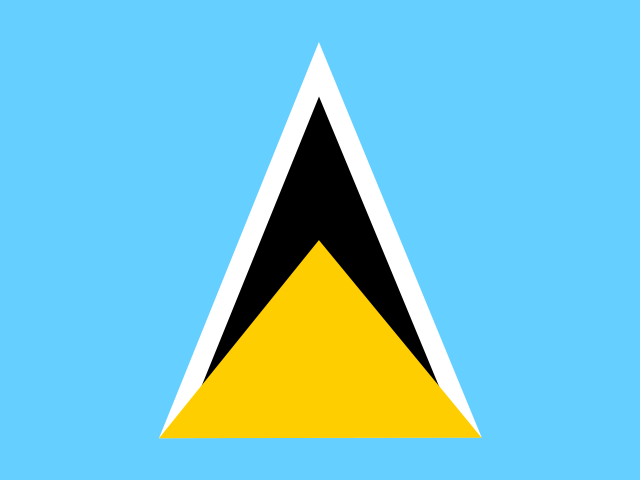
The Saint Lucian flag consists of a cerulean blue field with a central design composed of three triangles: a golden-yellow triangle at the base, a black arrowhead-shaped triangle in the middle, and a white triangle edging the black shape. The design represents the Pitons — the two volcanic peaks that are Saint Lucia's most famous landmark. The proportion is 1:2. The design was first adopted on 1 March 1967, when Saint Lucia became an associated state, and was standardized in its current form on 22 February 1979, when the country gained full independence from Britain.
Colors and meaning
Cerulean blue represents the Caribbean Sea and the Atlantic Ocean that surround Saint Lucia, gold represents the Caribbean sunshine and prosperity, black represents the volcanic origins of the island and the strength of its people, and white represents the island's famous beaches and the purity of its aspirations. The triangular shapes represent the Pitons, the iconic twin volcanic peaks of Saint Lucia.
Cerulean blue field
Represents the Caribbean Sea to the west and the Atlantic Ocean to the east, and the clear tropical skies above Saint Lucia. The specific shade of cerulean blue is one of the most distinctive national flag colors in the world.
Golden-yellow triangle
Represents the Caribbean sunshine that bathes the island year-round, and prosperity and hope for the future. The gold triangle also represents the base of the Pitons — the twin volcanic peaks that are Saint Lucia's most famous landmark.
Black arrowhead
Represents the volcanic origins of Saint Lucia — the island was formed by volcanic activity and its landscape is dominated by volcanic peaks. Black also represents the strength, resilience and cultural heritage of the Saint Lucian people, the majority of whom are descendants of African slaves brought to the island during the colonial period.
White triangle
Represents the white sand beaches that line Saint Lucia's coast, and the purity of the nation's aspirations. The white triangle frames the black arrowhead, giving the design a sharp, striking appearance.
Design origin
The flag was designed by Dunstan St. Omer, a Saint Lucian artist, and was first adopted on 1 March 1967, when Saint Lucia became an associated state of the United Kingdom. When Saint Lucia gained full independence on 22 February 1979, the flag was standardized in its current form, with the central emblem slightly adjusted.
History and adoption
Saint Lucia was a British colony from 1814 until 1967, when it became an associated state with full internal self-government. The flag was designed by Dunstan St. Omer in 1967 and adopted on 1 March 1967. When Saint Lucia gained full independence on 22 February 1979 as a Commonwealth realm, the flag was standardized in its current form. It has remained unchanged since, including through the country's development as a tourism destination and its role in Caribbean regional politics.
Key facts
- Adopted
- 1 March 1967 (current version 22 February 1979)
- Proportion
- 1:2
- Designer
- Dunstan St. Omer
- Capital
- Castries
- Country code
- LC
- Similar flags
- None
Historical and related flags
Saint Lucia used several flags during its French and British colonial periods before independence.
- French Saint Lucia (1650–1814): French colonial flags used during alternating French and British rule.
- British Saint Lucia (1814–1958): British Blue Ensign with a colonial badge.
- West Indies Federation (1958–1962): Blue field with four white wavy stripes and a yellow sun.
- Associated state (1967–1979): Current design first adopted.
- Current flag (1979–present): Standardized design with central emblem.
- Governor-General's standard: Uses the Saint Lucian coat of arms with two roseau cane stalks and a parrot.
Frequently asked questions
What does the flag of Saint Lucia look like?
The flag of Saint Lucia is a cerulean blue field with a golden-yellow triangle in the center, overlaid by a black arrowhead-shaped triangle and edged by a white triangle. The proportion is 1:2.
When was the flag of Saint Lucia adopted?
The current flag of Saint Lucia was officially adopted on 1 March 1967 (current version 22 February 1979).
What do the colors mean?
Cerulean blue represents the Caribbean Sea and the Atlantic Ocean that surround Saint Lucia, gold represents the Caribbean sunshine and prosperity, black represents the volcanic origins of the island and the strength of its people, and white represents the island's famous beaches and the purity of its aspirations. The triangular shapes represent the Pitons, the iconic twin volcanic peaks of Saint Lucia.
Which flags look similar to the Saint Lucia flag?
No other national flag closely resembles Saint Lucia's. The combination of a cerulean blue field with triangular shapes representing the Pitons is unique.

 Grenada
 Saint Vincent and the Grenadines
 Dominica
 Martinique
 Barbados
 Trinidad and Tobago