What the flag looks like
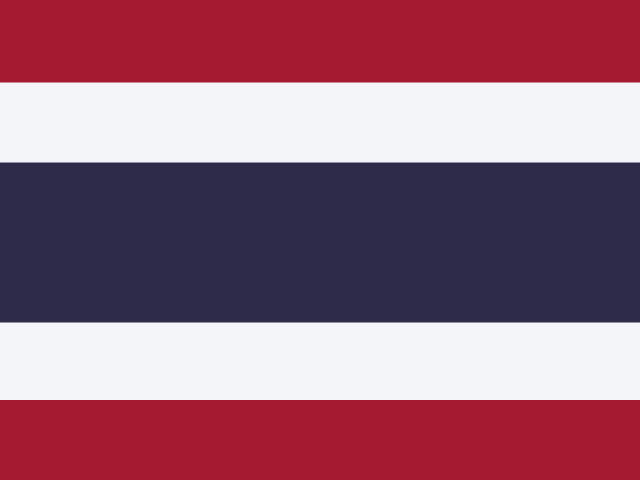
The Thai flag consists of five horizontal bands: red at the top and bottom, white stripes inside them, and a blue center band twice as wide as each of the other bands. The proportion is 2:3. It was adopted on 28 September 1917 by King Vajiravudh (Rama VI) and is known as the Trairanga (tricolor) or Thong Trairong.
Colors and meaning
Red represents the blood shed for Thai independence and the Thai nation, white represents the purity of Buddhism and the Thai people, and blue represents the monarchy and the Thai king. The three colors together are said to stand for nation, religion and king — the three pillars of Thai identity.
Red
Represents the Thai nation and the blood shed by Thai people in defense of their country. It appears in the outer bands of the flag.
White
Represents Buddhism, the dominant religion of Thailand, and the purity of the Thai people. It appears in the two inner stripes.
Blue
Represents the Thai monarchy, which is deeply revered in Thai culture. Blue was King Vajiravudh's lucky color — he was born on a Saturday, which is associated with blue in Thai tradition.
Nation, Religion, King
The three colors together symbolize the three pillars of Thai identity: chat (nation), satsana (religion) and phra mahakasat (king). This triad is a central concept in Thai nationalism.
History and adoption
Thailand (then Siam) used several flags before the current design. The first national flag, adopted in 1855 by King Mongkut (Rama IV), was a plain red flag with a white elephant. In 1916, King Vajiravudh added white stripes to the red flag after seeing a flag flown upside-down during a flood. In 1917, the current design was adopted, with the center stripe changed from red to blue — a color associated with the king and with the Allied powers during World War I, in which Siam had joined. The design has remained unchanged since, and the Thai flag is celebrated every 28 September as National Flag Day.
Key facts
- Adopted
- 28 September 1917
- Proportion
- 2:3
- Designer
- King Vajiravudh (Rama VI)
- Capital
- Bangkok
- Country code
- TH
- Similar flags
- Costa Rica, North Korea
Historical and related flags
Thailand has used several flags across its history, including a famous elephant flag.
- Plain red flag (pre-1855): Used as an early Siamese flag.
- Elephant flag (1855–1916): Red field with a white elephant, symbol of the monarchy.
- First striped flag (1916–1917): Red and white horizontal stripes.
- Current flag (1917–present): Red, white and blue bands with blue center.
- Naval ensign: Adds a red circle with a white elephant in the center.
- War flag: Similar to the naval ensign with additional elements.
Frequently asked questions
What does the flag of Thailand look like?
The flag of Thailand has five horizontal bands: red (top and bottom), white (inner stripes) and blue (center band, twice as wide). The proportion is 2:3.
When was the flag of Thailand adopted?
The current flag of Thailand was officially adopted on 28 September 1917.
What do the colors mean?
Red represents the blood shed for Thai independence and the Thai nation, white represents the purity of Buddhism and the Thai people, and blue represents the monarchy and the Thai king. The three colors together are said to stand for nation, religion and king — the three pillars of Thai identity.
Which flags look similar to the Thailand flag?
Costa Rica uses blue-white-red-white-blue — the reverse color order with blue on the outside. North Korea uses blue-white-red with a red star. Thailand's red-white-blue-white-red is distinct from both.

 Laos
 Cambodia
 Myanmar
 Vietnam
 Malaysia
 Indonesia