What the flag looks like
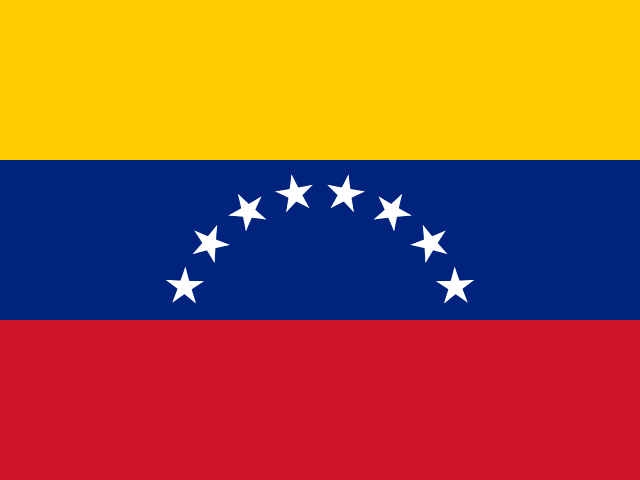
The Venezuelan flag consists of three equal horizontal bands of yellow (top), blue (middle) and red (bottom), with an arc of eight white five-pointed stars centered on the blue band. The state flag (used by government institutions) adds the Venezuelan coat of arms in the upper hoist corner. The proportion is 2:3. The current design was adopted on 12 March 2006, adding an eighth star.
Colors and meaning
Yellow represents the gold, wealth and natural resources of Venezuela, blue represents the Caribbean Sea that borders the country to the north, and red represents the blood shed by Venezuelan patriots in the struggle for independence. The eight white stars represent the eight provinces that signed the Venezuelan Declaration of Independence in 1811.
Yellow
Represents the gold, wealth and natural resources of Venezuela, and the sun that shines over the country. It is the top band and the largest band on the flag.
Blue
Represents the Caribbean Sea, which forms Venezuela's entire northern coastline, and the country's maritime heritage.
Red
Represents the blood shed by Venezuelan patriots during the long struggle for independence from Spain, achieved in 1821 at the Battle of Carabobo.
Eight stars
Represent the eight provinces that signed the Venezuelan Declaration of Independence on 5 July 1811: Caracas, Cumaná, Barinas, Margarita, Barcelona, Mérida, Trujillo and Guayana.
Coat of arms (state flag)
The state flag includes the Venezuelan coat of arms, which features a white horse running free, two cornucopias, and a bundle of arrows tied with a ribbon — symbols of independence, abundance and unity.
History and adoption
The Venezuelan flag was designed by Francisco de Miranda, who first raised a yellow-blue-red flag in 1806 at Jacmel, Haiti, on his failed expedition to liberate Venezuela from Spain. The design was used by the First Republic in 1811 with seven stars. In 1817, Simón Bolívar added an eighth star to represent the province of Guayana. The flag was used by Gran Colombia until 1830, when Venezuela became independent and adopted the tricolor with seven stars. The eighth star was restored in 2006 under President Hugo Chávez. In 2006, the coat of arms was also modified — the horse, which had been running to the right, now runs to the left, and additional elements were added.
Key facts
- Adopted
- 12 March 2006
- Proportion
- 2:3
- Designer
- Francisco de Miranda (original design)
- Capital
- Caracas
- Country code
- VE
- Similar flags
- Colombia, Ecuador
Historical and related flags
Venezuela has used several flags since independence, with the number of stars and the design of the coat of arms changing over time.
- First Republic (1811–1812): Yellow-blue-red tricolor with seven stars.
- Gran Colombia (1819–1830): Same tricolor, no stars.
- Independent Venezuela (1830–1859): Yellow-blue-red tricolor with seven stars and coat of arms.
- Federal Venezuela (1859–1863): Variations with different star arrangements.
- Venezuela (1863–2006): Seven stars, various coat of arms designs.
- Bolivarian Republic (2006–present): Eight stars added, horse direction changed.
Frequently asked questions
What does the flag of Venezuela look like?
The flag of Venezuela has three equal horizontal bands of yellow (top), blue (middle) and red (bottom), with an arc of eight white five-pointed stars in the center of the blue band. The state flag adds the Venezuelan coat of arms in the upper hoist corner. The proportion is 2:3.
When was the flag of Venezuela adopted?
The current flag of Venezuela was officially adopted on 12 March 2006.
What do the colors mean?
Yellow represents the gold, wealth and natural resources of Venezuela, blue represents the Caribbean Sea that borders the country to the north, and red represents the blood shed by Venezuelan patriots in the struggle for independence. The eight white stars represent the eight provinces that signed the Venezuelan Declaration of Independence in 1811.
Which flags look similar to the Venezuela flag?
Colombia and Ecuador use the same yellow-blue-red horizontal bands, with different emblems. Colombia's is the same but has no stars or coat of arms. Ecuador's includes the national coat of arms in the center. Venezuela's arc of eight stars is unique.

 Colombia
 Ecuador
 Panama
 Brazil
 Guyana
 Trinidad and Tobago