What the flag looks like
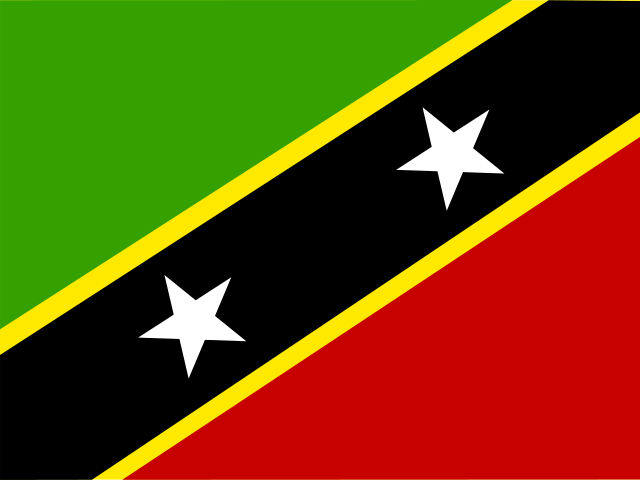
The flag of Saint Kitts and Nevis is divided diagonally from the lower hoist corner to the upper fly corner by a black band with yellow borders on both sides. The upper triangle (toward the hoist and top) is green, and the lower triangle (toward the fly and bottom) is red. On the black band are two white five-pointed stars. The proportion is 2:3. It was adopted on 19 September 1983, when Saint Kitts and Nevis gained independence from Britain.
Colors and meaning
Green represents the fertility of the islands' land, yellow represents the year-round sunshine of the Caribbean, black represents the African heritage of the majority of the population, red represents the blood shed in the struggle for independence and the country's energy, and the two white stars represent the two islands of the federation — Saint Kitts and Nevis — and hope, liberty and peace.
Green triangle
Represents the fertile land and agricultural wealth of the two islands, particularly their historic sugar cane industry. The green triangle is on the hoist side, suggesting hope and growth.
Yellow borders
The yellow bands that border the black diagonal stripe represent the year-round Caribbean sunshine that bathes the islands and supports their agriculture and tourism industries.
Black diagonal band
Represents the African heritage of the majority of the population, who are descendants of African slaves brought to the islands during the colonial period. Black also represents the strength and resilience of the Kittitian and Nevisian people.
Red triangle
Represents the blood shed by patriots in the struggle for independence and the energy and vitality of the people of Saint Kitts and Nevis.
Two white stars
Represent the two islands that make up the federation — Saint Kitts (Saint Christopher) and Nevis. The stars also represent hope, liberty and peace. Their white color stands for purity and the aspiration for a peaceful and prosperous future.
Design origin
The flag was designed by Edrice Lewis, a Kittitian teacher, in a national competition held in preparation for independence. It was adopted on 19 September 1983, the day the country became independent from Britain. The design was chosen to represent both islands of the federation equally, with the two stars standing for their shared nationhood.
History and adoption
Saint Kitts and Nevis was a British colony from 1623 (Saint Kitts) and 1628 (Nevis) until 1983, when it gained full independence on 19 September 1983 as a Commonwealth realm. The flag was designed by Edrice Lewis, a Kittitian teacher, in a national competition held in preparation for independence. It was adopted on independence day and has remained unchanged since, including through the political tension between the two islands that led Nevis to consider secession in 1998 (the proposal was defeated in a referendum).
Key facts
- Adopted
- 19 September 1983
- Proportion
- 2:3
- Designer
- Edrice Lewis
- Capital
- Basseterre
- Country code
- KN
- Similar flags
- None
Historical and related flags
Saint Kitts and Nevis used several flags during its British colonial period before independence.
- British Saint Kitts (1623–1958): British Blue Ensign with a colonial badge.
- West Indies Federation (1958–1962): Blue field with four white wavy stripes and a yellow sun.
- British Saint Kitts-Nevis-Anguilla (1962–1967): Blue Ensign with a combined colonial badge.
- Associated state (1967–1983): Blue Ensign with the combined colonial badge; Anguilla separated in 1967 and remains a British territory.
- Current flag (1983–present): Green, yellow, black and red diagonal with two white stars.
- Governor-General's standard: Uses the Kittitian and Nevisian coat of arms with a pelican and a ship.
Frequently asked questions
What does the flag of Saint Kitts and Nevis look like?
The flag of Saint Kitts and Nevis is divided diagonally by a black band with yellow borders, running from the lower hoist to the upper fly. The upper left triangle is green and the lower right triangle is red, and two white five-pointed stars sit on the black band. The proportion is 2:3.
When was the flag of Saint Kitts and Nevis adopted?
The current flag of Saint Kitts and Nevis was officially adopted on 19 September 1983.
What do the colors mean?
Green represents the fertility of the islands' land, yellow represents the year-round sunshine of the Caribbean, black represents the African heritage of the majority of the population, red represents the blood shed in the struggle for independence and the country's energy, and the two white stars represent the two islands of the federation — Saint Kitts and Nevis — and hope, liberty and peace.
Which flags look similar to the Saint Kitts and Nevis flag?
No other national flag closely resembles Saint Kitts and Nevis'. The combination of a green and red diagonal with a black-yellow band and two white stars is unique.

 Antigua and Barbuda
 Dominica
 Saint Lucia
 Grenada
 Barbados
 British Virgin Islands