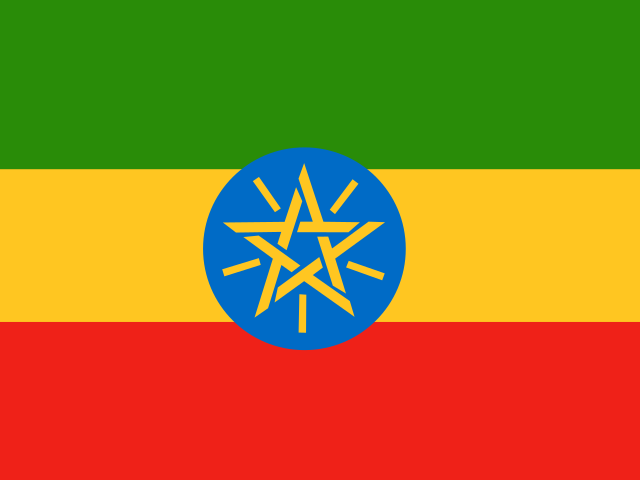
What the flag looks like
The Ethiopian flag consists of three equal horizontal bands of green (top), yellow (middle) and red (bottom). Centered on the flag is a blue disc bearing a yellow five-pointed star with rays emanating between its points. The proportion is 1:2. The tricolor dates back to the 19th century, and the current version with the emblem was adopted on 6 February 2009.
Colors and meaning
Green represents the fertility of the Ethiopian land, its agriculture and hope, yellow represents peace, harmony and the country's religious heritage, and red represents the blood shed for Ethiopian independence and the sacrifices of its people. The blue disc represents peace, and the yellow star represents the unity of the Ethiopian people and their diversity.
Green
Represents the fertility of the Ethiopian land, its agriculture and hope for the future. Ethiopia is one of the oldest agricultural regions in the world and the birthplace of coffee.
Yellow
Represents peace, harmony and the country's religious heritage — Ethiopia has been a Christian nation since the 4th century and has a significant Muslim population as well. Yellow also represents the sun and hope.
Red
Represents the blood shed by Ethiopian patriots in defense of their nation, including the victory over Italian forces at the Battle of Adwa in 1896 — the first major African victory over a European colonial power.
Blue disc
Represents peace and the diversity of the Ethiopian people.
Yellow star and rays
The five-pointed star with rays between its points represents the unity of Ethiopia's diverse peoples and their common future, and the rays represent the brightness of that future.
History and adoption
Ethiopia is one of the oldest countries in the world and was never colonized by a European power, though it was briefly occupied by Italy from 1936 to 1941. The green-yellow-red tricolor dates back to the reign of Emperor Menelik II in the late 19th century and was formalized under Emperor Haile Selassie in 1914. The tricolor became the basis for the Pan-African colors adopted by many newly independent African countries. The current flag, with the blue disc and yellow star emblem, was adopted on 6 February 2009 by the Federal Democratic Republic of Ethiopia, replacing the earlier version that had been in use since 1996. The tricolor base has remained unchanged since the 19th century.
Key facts
- Adopted
- 6 February 2009
- Proportion
- 1:2
- Designer
- Tricolor traditional; emblem designed by the Federal Democratic Republic
- Capital
- Addis Ababa
- Country code
- ET
- Similar flags
- Ghana, Bolivia, Lithuania
Historical and related flags
Ethiopia has used several flags across its imperial, Derg and federal periods.
- Ethiopian Empire (pre-1897): Various imperial banners with the Lion of Judah.
- Ethiopian Empire (1897–1974): Green-yellow-red tricolor with the Lion of Judah.
- Derg (1974–1987): Tricolor with a socialist emblem of a plough, cogwheel and rifle.
- People's Democratic Republic of Ethiopia (1987–1991): Tricolor with the same emblem.
- Transitional Government (1991–1996): Plain tricolor without emblem.
- Federal Democratic Republic (1996–2009): Tricolor with a blue disc and yellow star emblem.
- Current flag (2009–present): Updated emblem with brighter colors and more distinct rays.
Frequently asked questions
What does the flag of Ethiopia look like?
The flag of Ethiopia has three equal horizontal bands of green (top), yellow (middle) and red (bottom), with a blue disc bearing a yellow five-pointed star and rays in the center. The proportion is 1:2.
When was the flag of Ethiopia adopted?
The current flag of Ethiopia was officially adopted on 6 February 2009.
What do the colors mean?
Green represents the fertility of the Ethiopian land, its agriculture and hope, yellow represents peace, harmony and the country's religious heritage, and red represents the blood shed for Ethiopian independence and the sacrifices of its people. The blue disc represents peace, and the yellow star represents the unity of the Ethiopian people and their diversity.
Which flags look similar to the Ethiopia flag?
Ghana uses red-gold-green with a black star. Bolivia uses red-yellow-green without an emblem. Lithuania uses yellow-green-red — a different order. Ethiopia's green-yellow-red with a blue disc and yellow star is unique, though its colors inspired many African flags.

 Ghana
 Kenya
 Sudan
 South Sudan
 Somalia
 Eritrea