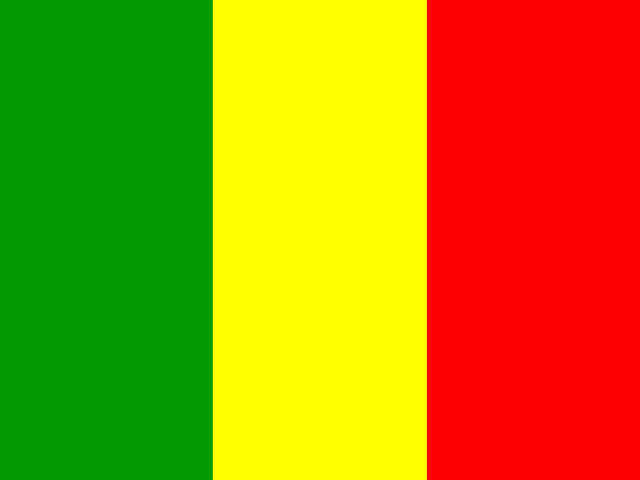
What the flag looks like
The Malian flag consists of three equal vertical bands of green (hoist), yellow (center) and red (fly). The proportion is 2:3. It was adopted on 1 March 1961, one year after Mali gained independence from France, and has remained unchanged since.
Colors and meaning
Green represents the fertility of the Malian land and hope for the future, yellow represents the country's mineral wealth and the purity of its people, and red represents the blood shed for Malian independence and the courage of the Malian people. Together the colors are the Pan-African colors, adopted by many newly independent African states.
Green
Represents the fertility of the Malian land, its agriculture and hope for the future. Mali is home to the Niger River, whose inland delta is one of the most fertile regions in West Africa.
Yellow
Represents Mali's mineral wealth — the country is one of Africa's largest gold producers — and the purity of the Malian people.
Red
Represents the blood shed by Malian patriots in the struggle for independence from France, achieved in 1960, and the courage and sacrifice of the Malian people.
Pan-African colors
The green, yellow and red are the Pan-African colors, first used by Ethiopia and adopted by many newly independent African states as a symbol of African unity and independence. Mali's flag was designed to reflect this shared African identity.
History and adoption
Mali was a French colony known as French Sudan from 1890 until 1959, when it joined with Senegal to form the Mali Federation. The Mali Federation adopted a flag with green, yellow and red vertical bands and a black human figure (the kanaga) in the center. The federation dissolved in August 1960, and Senegal withdrew. On 22 September 1960, French Sudan became the independent Republic of Mali. The following year, on 1 March 1961, Mali removed the black kanaga figure from the flag, leaving the plain green-yellow-red tricolor that has remained in use ever since.
Key facts
- Adopted
- 1 March 1961
- Proportion
- 2:3
- Designer
- Based on the Mali Federation flag
- Capital
- Bamako
- Country code
- ML
- Similar flags
- Senegal, Guinea, Cameroon
Historical and related flags
Mali has used two flags since independence, with the first featuring a traditional African symbol.
- French Sudan (1890–1959): French flag used during colonial rule.
- Mali Federation (1959–1960): Green-yellow-red with a black kanaga figure in the center.
- Current flag (1961–present): Plain green-yellow-red tricolor.
- Presidential standard: Uses the Malian coat of arms with a vulture and a rising sun.
Frequently asked questions
What does the flag of Mali look like?
The flag of Mali has three equal vertical bands of green (hoist), yellow (center) and red (fly). The proportion is 2:3.
When was the flag of Mali adopted?
The current flag of Mali was officially adopted on 1 March 1961.
What do the colors mean?
Green represents the fertility of the Malian land and hope for the future, yellow represents the country's mineral wealth and the purity of its people, and red represents the blood shed for Malian independence and the courage of the Malian people. Together the colors are the Pan-African colors, adopted by many newly independent African states.
Which flags look similar to the Mali flag?
Senegal uses the same green-yellow-red vertical bands with a green star in the center. Guinea uses red-yellow-green with a red star. Cameroon uses green-red-yellow with a yellow star. Mali's plain green-yellow-red tricolor is unique for its lack of any emblem.

 Senegal
 Guinea
 Burkina Faso
 Niger
 Mauritania
 Ivory Coast