What the flag looks like
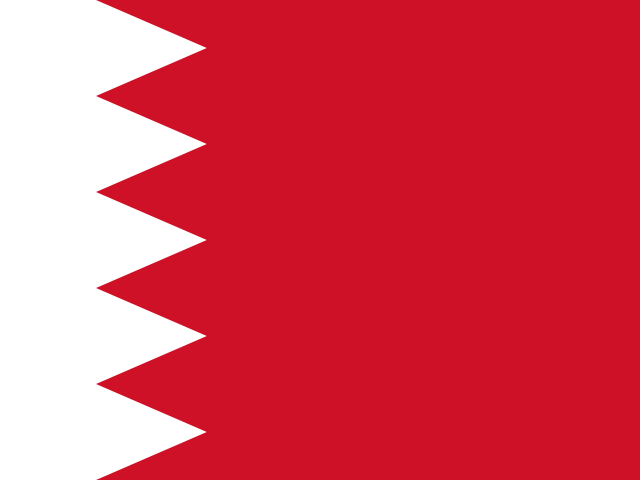
The Bahraini flag consists of a red field with a white band on the hoist side, separated by a serrated edge with five white points. The proportion is 3:5. The current design was adopted on 14 February 2002, when Bahrain became a kingdom, though the base design dates from 1932.
Colors and meaning
Red represents the blood shed by Bahraini patriots in the struggle for independence, and the country's historic connection to the Kharijite and other Islamic movements that used red banners. White represents peace and purity. The five points of the serrated edge represent the Five Pillars of Islam.
Red
Represents the blood shed by Bahraini patriots in the struggle for independence, and Bahrain's historic connection to the red banners used by early Islamic movements, particularly the Kharijites and the Qarmatians who ruled the region in the medieval period.
White
Represents peace, purity and the desire for peaceful development. The white band on the hoist side is separated from the red field by a serrated edge.
Five points
The five white points of the serrated line represent the Five Pillars of Islam — Shahada (faith), Salat (prayer), Zakat (charity), Sawm (fasting) and Hajj (pilgrimage). The number five was fixed in 2002 when Bahrain became a kingdom, replacing the earlier eight-point design.
Design history
The flag's base design dates from 1932, when the British adviser to Bahrain, Charles Belgrave, recommended standardizing the flag with a serrated edge. The original serrated design had 28 white points, later reduced to eight, and finally to five in 2002.
History and adoption
Bahrain was a British protectorate from 1861 until 1971, when it gained independence on 15 August 1971. The flag's base design — a red field with a white band and a serrated edge — dates from 1932, when the British adviser to Bahrain standardized the flag. The serrated design had 28 points, which was reduced to eight in 1972. On 14 February 2002, when Bahrain became a kingdom under King Hamad bin Isa Al Khalifa, the flag was updated to its current design with five white points representing the Five Pillars of Islam. The proportion was also standardized to 3:5. The flag has remained unchanged since.
Key facts
- Adopted
- 14 February 2002
- Proportion
- 3:5
- Designer
- Charles Belgrave (1932 design), standardized by the Bahraini government
- Capital
- Manama
- Country code
- BH
- Similar flags
- Qatar
Historical and related flags
Bahrain has used several flags across its history.
- Early Bahraini flags (19th century): Plain red flag.
- British protectorate (1861–1932): Red flag with a white band, sometimes with a serrated edge.
- First serrated design (1932–1972): Red field with a white serrated band of 28 points.
- Second design (1972–2002): Red field with a white serrated band of eight points.
- Current flag (2002–present): Red field with a white serrated band of five points.
- Royal standard: Uses the Bahraini coat of arms with a red field and white serrated edge, plus a crown.
Frequently asked questions
What does the flag of Bahrain look like?
The flag of Bahrain is a red field with a white band on the hoist side, separated by a serrated (zigzag) line with five white points. The proportion is 3:5.
When was the flag of Bahrain adopted?
The current flag of Bahrain was officially adopted on 14 February 2002.
What do the colors mean?
Red represents the blood shed by Bahraini patriots in the struggle for independence, and the country's historic connection to the Kharijite and other Islamic movements that used red banners. White represents peace and purity. The five points of the serrated edge represent the Five Pillars of Islam.
Which flags look similar to the Bahrain flag?
Qatar uses a similar white and maroon design with a serrated edge, but with nine points instead of five, a maroon (dark red-brown) color instead of bright red, and 11:28 proportions. Bahrain's bright red and five-point design clearly distinguish it from Qatar's flag.

 Qatar
 Saudi Arabia
 United Arab Emirates
 Kuwait
 Oman
 Iran