What the flag looks like
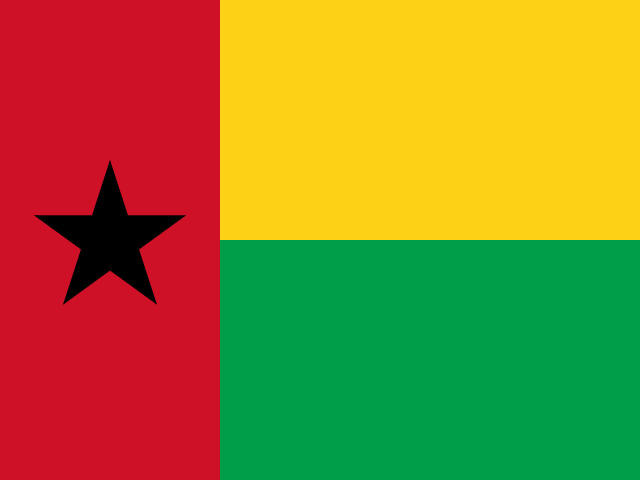
The flag of Guinea-Bissau consists of a vertical red band on the hoist side bearing a black five-pointed star, and two horizontal bands on the fly side — yellow on top and green on the bottom. The proportion is 1:2. It was adopted on 24 September 1973, when the country declared independence from Portugal, and was formally recognized after Portugal's Carnation Revolution in 1974.
Colors and meaning
Red represents the blood shed during the long struggle for independence from Portugal and the sacrifices of the Guinean people, yellow represents the sun, hope and the country's mineral wealth, green represents the forests and agricultural wealth of the country, and the black star represents Africa and the African people — a symbol of Pan-Africanism.
Red
Represents the blood shed by Guinean patriots during the long armed struggle for independence from Portugal, led by the African Party for the Independence of Guinea and Cape Verde (PAIGC) from 1963 to 1974.
Yellow
Represents the sun, hope for the future and the country's mineral and agricultural wealth. Guinea-Bissau has significant reserves of bauxite and phosphates.
Green
Represents the forests, agricultural land and natural environment of Guinea-Bissau. The country has extensive mangrove forests and is a major producer of cashew nuts.
Black star
Represents Africa and the African people, and is a symbol of Pan-Africanism. The star is derived from the flag of Ghana, which was the first sub-Saharan African country to gain independence and used the black star as a symbol of African emancipation.
Design origin
The flag was adopted by the PAIGC during the independence war and is based on the flag of Ghana, with the horizontal bands rearranged and a vertical red band added. It was designed to reflect the close ties between Guinea-Bissau and Cape Verde, which were jointly administered by Portugal before independence.
History and adoption
Guinea-Bissau was a Portuguese colony from the 15th century until 1973. The African Party for the Independence of Guinea and Cape Verde (PAIGC), led by Amílcar Cabral, began an armed struggle in 1963 and declared independence unilaterally on 24 September 1973. The flag was adopted on that day, designed by Cabral and the PAIGC leadership. Portugal recognized Guinea-Bissau's independence on 10 September 1974, after its own Carnation Revolution. The flag has remained unchanged since, despite the political instability that has marked the country's post-independence history.
Key facts
- Adopted
- 24 September 1973
- Proportion
- 1:2
- Designer
- Amílcar Cabral and the PAIGC
- Capital
- Bissau
- Country code
- GW
- Similar flags
- Ghana, Cameroon, Senegal
Historical and related flags
Guinea-Bissau has used the same flag since declaring independence, with one proposed variation for the union with Cape Verde.
- Portuguese Guinea (1474–1973): Portuguese flag used during colonial rule.
- PAIGC flag (1963–1973): Same design used during liberation struggle.
- Current flag (1973–present): Red vertical band with black star, yellow and green horizontal bands.
- Proposed flag for union with Cape Verde: Never adopted; the two countries separated in 1980.
Frequently asked questions
What does the flag of Guinea-Bissau look like?
The flag of Guinea-Bissau has a vertical red band on the hoist with a black five-pointed star, and two horizontal bands of yellow (top) and green (bottom) on the fly. The proportion is 1:2.
When was the flag of Guinea-Bissau adopted?
The current flag of Guinea-Bissau was officially adopted on 24 September 1973.
What do the colors mean?
Red represents the blood shed during the long struggle for independence from Portugal and the sacrifices of the Guinean people, yellow represents the sun, hope and the country's mineral wealth, green represents the forests and agricultural wealth of the country, and the black star represents Africa and the African people — a symbol of Pan-Africanism.
Which flags look similar to the Guinea-Bissau flag?
Ghana uses red, gold and green with a black star in the center. Cameroon uses green-red-yellow with a yellow star. Guinea-Bissau's vertical red hoist band with a black star, beside yellow and green horizontal bands, is unique.

 Senegal
 Guinea
 Gambia
 Cape Verde
 Sierra Leone
 Ghana