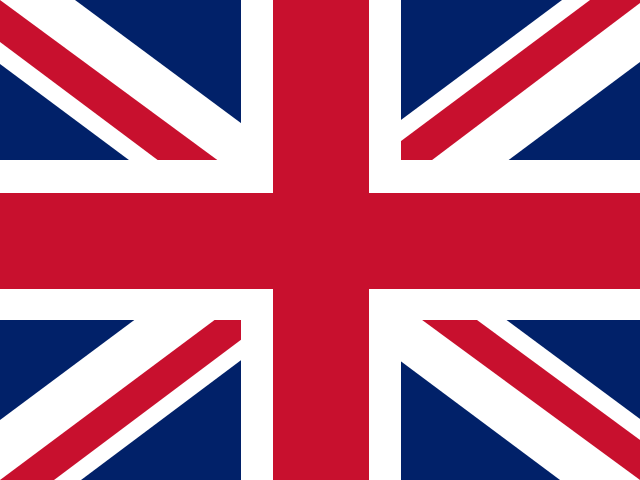
What the flag looks like
The Union Jack combines three heraldic crosses: the red cross of St George (England) on a white ground, the white saltire of St Andrew (Scotland) on a blue field, and the red saltire of St Patrick (Ireland). The proportion is 1:2 for land use and 1:2 at sea. The flag was adopted on 1 January 1801 with the Act of Union that joined the Kingdom of Great Britain and the Kingdom of Ireland.
Colors and meaning
Blue represents the sea and St Andrew's saltire, white represents peace and St Andrew's cross, and red represents the crosses of St George and St Patrick. The three crosses together represent the union of England, Scotland and Ireland under one crown.
Blue
The field of the flag and the background of the Scottish saltire. Represents the sea, truth and loyalty.
White
The border of St George's cross and the saltire of St Andrew. Represents peace and purity.
Red
The cross of St George (England) and the saltire of St Patrick (Ireland). Represents strength, bravery and the blood of the union's defenders.
St George's Cross
A red cross on white, the national flag of England since the Middle Ages.
St Andrew's Saltire
A white diagonal cross on blue, the national flag of Scotland.
St Patrick's Saltire
A red diagonal cross on white, representing Ireland in the union.
History and adoption
The first Union Flag was created in 1606, combining the crosses of St George (England) and St Andrew (Scotland) after the Union of the Crowns in 1603. The current design dates from 1 January 1801, when the Act of Union joined Great Britain and Ireland and the cross of St Patrick was added. The flag has remained unchanged since, even after the partition of Ireland in 1921, because the cross of St Patrick continues to represent Northern Ireland in the union.
Key facts
- Adopted
- 1 January 1801
- Proportion
- 1:2
- Designer
- Unknown — heraldic design formalized by royal proclamation
- Capital
- London
- Country code
- GB
- Similar flags
- None
Historical and related flags
The Union Jack has had several forms across the history of the British Isles.
- First Union Flag (1606–1801): Crosses of St George and St Andrew only, without St Patrick's saltire.
- Current Union Jack (1801–present): Adds the cross of St Patrick for Ireland.
- Commonwealth flags: Australia, New Zealand, Tuvalu and Fiji incorporate the Union Jack in their cantons.
- Hawaii state flag: Uses the Union Jack in the canton, a legacy of British influence in the 19th century.
Frequently asked questions
What does the flag of United Kingdom look like?
The flag of the United Kingdom is the Union Jack: a blue field with the red cross of St George edged in white, overlain with the white diagonal cross of St Andrew and the red diagonal cross of St Patrick.
When was the flag of United Kingdom adopted?
The current flag of United Kingdom was officially adopted on 1 January 1801.
What do the colors mean?
Blue represents the sea and St Andrew's saltire, white represents peace and St Andrew's cross, and red represents the crosses of St George and St Patrick. The three crosses together represent the union of England, Scotland and Ireland under one crown.
Which flags look similar to the United Kingdom flag?
No other national flag closely resembles the Union Jack. Hawaii incorporates it in its canton as a historical reference to British influence.

 Ireland
 Australia
 New Zealand
 Canada
 France
 Hawaii