What the flag looks like
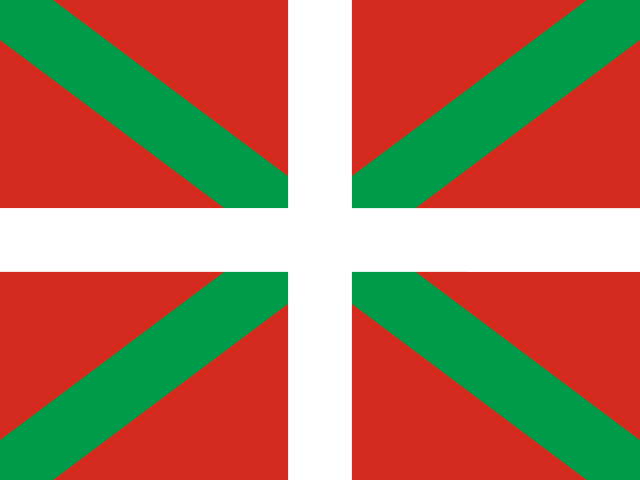
The Basque flag, known as the Ikurriña, consists of a red field with a white cross and a green saltire (diagonal cross) overlaid on each other, so that the white cross appears to be behind the green one. The proportion is 2:3. It was designed in 1894 by Sabino Arana and his brother Luis Arana — the founders of the Basque nationalist movement — and was adopted as the official flag of the Basque Autonomous Community in 1979, following the end of Franco's dictatorship.
Colors and meaning
Red represents the Basque people and the blood shed for Basque freedom, white represents the Christian faith of the Basque people, and green represents the oak tree of Gernika (Guernica) — the traditional symbol of Basque liberties — and the green mountains of the Basque Country.
Red field
Represents the Basque people and the blood shed for Basque freedom and self-government. Red is also the traditional color of the Basque provinces and appears on the historic flags of Biscay and other Basque territories.
White cross
Represents the Christian faith of the Basque people. The cross is drawn as a Latin cross that extends to the edges of the flag, with its arms of equal width.
Green saltire
Represents the Oak of Gernika — the ancient oak tree under which the lords of Biscay traditionally swore to uphold the Basque fueros (local laws and privileges). The oak is the most important symbol of Basque liberty and self-government, and its image appears on the Basque coat of arms. The green saltire also represents the green mountains that dominate the Basque landscape.
Design origin
The Ikurriña was designed in 1894 by Sabino Arana and his brother Luis Arana — the founders of the Basque Nationalist Party (PNV) — originally as a flag for the province of Biscay. It was later adopted as the flag of the entire Basque Country. Arana designed the flag based on the historic coats of arms of the Basque provinces, combining the red field of Biscay, the white cross of the old flag of Bilbao and the green saltire of the Oak of Gernika.
History and adoption
The Basque Country is a historic region spanning parts of northern Spain and southwestern France. The Ikurriña was designed in 1894 by Sabino Arana and his brother Luis Arana, initially as the flag of Biscay, and was soon adopted as the flag of the Basque nationalist movement. During the Second Spanish Republic (1931–1939), the flag was used unofficially by Basque autonomous institutions, and it was formally adopted as the flag of the Basque Autonomous Community after the Spanish transition to democracy. The Basque Statute of Autonomy, approved in 1979, recognized the Ikurriña as the official flag of the Basque Country. The flag has remained the most recognizable symbol of Basque identity and is used across the Basque Country in Spain — though it is not officially recognized in the French Basque Country (Iparralde).
Key facts
- Adopted
- 1894 (designed); 1979 (official in the Basque Autonomous Community)
- Proportion
- 2:3
- Designer
- Sabino Arana and Luis Arana
- Capital
- Vitoria-Gasteiz
- Country code
- ES-PV
- Similar flags
- None
Historical and related flags
The Ikurriña has been used in various forms since 1894, and related flags exist for the Basque territories and institutions.
- Original Ikurriña (1894): Designed for Biscay, later adopted for the whole Basque Country.
- Second Spanish Republic (1931–1939): Used unofficially by Basque autonomous institutions.
- Franco era (1939–1975): Banned; used only in exile and by resistance movements.
- Current flag (1979–present): Official flag of the Basque Autonomous Community.
- Flag of Navarre: Uses a different design — a red field with a golden chain and an emerald in the center.
- Iparralde (French Basque Country): The Ikurriña is widely used, but not officially recognized by French authorities.
Frequently asked questions
What does the flag of Basque Country look like?
The flag of the Basque Country, known as the Ikurriña, is a red field with a white cross (horizontal and vertical) overlaid by a green saltire (diagonal cross). The proportion is 2:3.
When was the flag of Basque Country adopted?
The current flag of Basque Country was officially adopted on 1894 (designed); 1979 (official in the Basque Autonomous Community).
What do the colors mean?
Red represents the Basque people and the blood shed for Basque freedom, white represents the Christian faith of the Basque people, and green represents the oak tree of Gernika (Guernica) — the traditional symbol of Basque liberties — and the green mountains of the Basque Country.
Which flags look similar to the Basque Country flag?
No other national or regional flag closely resembles the Basque Ikurriña. The combination of a red field with a white cross overlaid by a green saltire is unique, though it is sometimes compared to the flag of the United Kingdom (which also combines crosses) — but the colors and proportions are completely different.

 Spain
 France
 Catalonia
 Galicia
 European Union
 Andorra