What the flag looks like
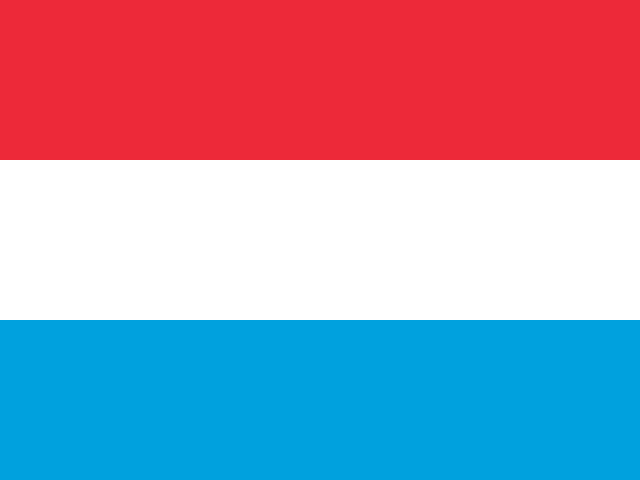
The Luxembourg flag consists of three equal horizontal bands of red (top), white (middle) and light blue (bottom). The proportion is 3:5. It was officially adopted on 23 June 1972, though the design has been in use since 1848. A separate ensign with a lion is used for maritime purposes to avoid confusion with the Dutch flag.
Colors and meaning
The colors are derived from the coat of arms of the House of Luxembourg, which featured a red lion on a field of blue and white stripes. Red represents courage and the blood shed for Luxembourg's independence, white represents peace, and light blue represents the sky, loyalty and the country's rivers.
Red
Derived from the red lion of the Luxembourg coat of arms. Represents courage, strength and the blood shed by Luxembourgers in defense of their nation.
White
Represents peace, purity and honesty. It is the middle band and one of the two colors of the historic coat of arms.
Light blue
Represents the sky, loyalty and the rivers and streams of the Grand Duchy. Luxembourg deliberately uses a lighter shade of blue than the Netherlands to distinguish its flag.
Red Lion of Luxembourg
The red lion on a field of blue and white stripes is one of the oldest coats of arms in Europe, dating back to the 13th century and the House of Luxembourg, which produced several Holy Roman Emperors.
History and adoption
Luxembourg's flag was first adopted in 1848, when the Grand Duchy became a constitutional monarchy. It was based on the colors of the Luxembourg coat of arms, which featured a red lion on a field of blue and white. The design was officially confirmed on 23 June 1972, when the exact shades of red, white and blue were standardized. Because the flag is nearly identical to that of the Netherlands, a separate red-white-blue ensign with the Luxembourg coat of arms is used on ships to avoid confusion. Luxembourg has used the tricolor continuously since 1848, with only brief interruptions during both World Wars.
Key facts
- Adopted
- 23 June 1972
- Proportion
- 3:5
- Designer
- Traditional — based on the House of Luxembourg coat of arms
- Capital
- Luxembourg City
- Country code
- LU
- Similar flags
- Netherlands
Historical and related flags
Luxembourg has used several flags across its history, and today uses several official variants.
- Duchy of Luxembourg (13th–18th century): Coat of arms of the House of Luxembourg — red lion on blue and white stripes.
- Under Dutch rule (1815–1890): Used the Dutch flag with Luxembourg emblem.
- First adoption (1848–1972): Tricolor used unofficially and semi-officially.
- Current flag (1972–present): Formally standardized.
- Civil ensign: Red-white-blue with a red lion.
- Naval ensign: Red lion on blue and white stripes.
Frequently asked questions
What does the flag of Luxembourg look like?
The flag of Luxembourg has three equal horizontal bands of red (top), white (middle) and light blue (bottom). The proportion is 3:5.
When was the flag of Luxembourg adopted?
The current flag of Luxembourg was officially adopted on 23 June 1972.
What do the colors mean?
The colors are derived from the coat of arms of the House of Luxembourg, which featured a red lion on a field of blue and white stripes. Red represents courage and the blood shed for Luxembourg's independence, white represents peace, and light blue represents the sky, loyalty and the country's rivers.
Which flags look similar to the Luxembourg flag?
The Netherlands uses a horizontal red-white-blue tricolor with a darker blue and different proportions. Luxembourg's blue is lighter, its proportions are 3:5 (Netherlands is 2:3), and its maritime ensign includes a lion.

 Netherlands
 Belgium
 Germany
 France
 Austria
 Switzerland