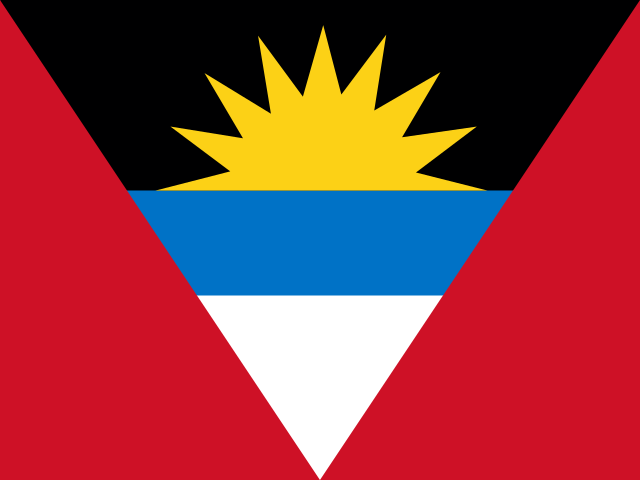
What the flag looks like
The flag of Antigua and Barbuda has a black section on the hoist side with a golden-yellow rising sun that has seven points. The rest of the flag is divided horizontally by a V-shape: the upper triangle is blue and the lower triangle is white, with the V pointing toward the sun. The proportion is 2:3. It was adopted on 27 February 1967, when Antigua and Barbuda became an associated state of the United Kingdom, and was retained when the country gained full independence on 1 November 1981.
Colors and meaning
Black represents the African heritage of the Antiguan and Barbudan people, blue represents hope and the Caribbean Sea, white represents the white sand of the country's beaches, red represents the lifeblood of the people — their energy and dynamism — and the golden-yellow rising sun represents the dawn of a new era for the nation. The seven points of the sun represent the seven parishes of Antigua, and the V-shape represents victory.
Black section
Represents the African heritage of the Antiguan and Barbudan people, the majority of whom are descendants of African slaves brought to the islands during the colonial period. Black also represents the soil and the strength of the people.
Blue upper band
Represents hope and the Caribbean Sea, which surrounds the two islands. Blue is a traditional color of Caribbean identity and appears on many flags of the region.
White lower band
Represents the white sand of Antigua's famous beaches — there are said to be 365 beaches, one for every day of the year. White also represents purity and peace.
Red rising sun
Represents the dawn of a new era for the nation, following independence. The rising sun is a symbol of hope, vitality and a bright future.
V-shape
Represents victory — the V-shape is a universal symbol of triumph and has been used in the country's flag since 1967, when Antigua and Barbuda became an associated state. The V-shape points toward the sun, symbolizing the country moving forward toward a bright future.
Seven-pointed sun
Represents the seven parishes of Antigua — Saint John, Saint Peter, Saint George, Saint Mary, Saint Paul, Saint Philip and Saint Elizabeth — which together form the main island of Antigua.
History and adoption
Antigua and Barbuda was a British colony from 1632 (Antigua) and 1678 (Barbuda) until 1967, when it became an associated state of the United Kingdom with full internal self-government. The flag was designed by Sir Reginald Samuel, an Antiguan artist, in a national competition held in 1966 in preparation for associated statehood. It was adopted on 27 February 1967, when Antigua and Barbuda became an associated state, and was retained when the country gained full independence on 1 November 1981 as a Commonwealth realm. The flag has remained unchanged since.
Key facts
- Adopted
- 27 February 1967
- Proportion
- 2:3
- Designer
- Sir Reginald Samuel
- Capital
- Saint John's
- Country code
- AG
- Similar flags
- None
Historical and related flags
Antigua and Barbuda used several flags during its British colonial period before associated statehood and independence.
- British Antigua (1632–1958): British Blue Ensign with a colonial badge.
- West Indies Federation (1958–1962): Blue field with four white wavy stripes and a yellow sun.
- British Antigua and Barbuda (1962–1967): Blue Ensign with a colonial badge.
- Current flag (1967–present): Black, blue and white sections with red rising sun.
- Governor-General's standard: Uses the Antiguan and Barbudan coat of arms with a pineapple and a sugar mill.
Frequently asked questions
What does the flag of Antigua and Barbuda look like?
The flag of Antigua and Barbuda is divided into a black hoist section, a blue upper band, a white lower band, and a red rising sun on the black section. The V-shape design represents the 'V' of victory, and the sun has seven points representing the seven parishes of Antigua. The proportion is 2:3.
When was the flag of Antigua and Barbuda adopted?
The current flag of Antigua and Barbuda was officially adopted on 27 February 1967.
What do the colors mean?
Black represents the African heritage of the Antiguan and Barbudan people, blue represents hope and the Caribbean Sea, white represents the white sand of the country's beaches, red represents the lifeblood of the people — their energy and dynamism — and the golden-yellow rising sun represents the dawn of a new era for the nation. The seven points of the sun represent the seven parishes of Antigua, and the V-shape represents victory.
Which flags look similar to the Antigua and Barbuda flag?
No other national flag closely resembles Antigua and Barbuda's. The combination of black, blue and white sections with a red rising sun and V-shape is unique.

 Grenada
 Saint Lucia
 Saint Vincent and the Grenadines
 Dominica
 Barbados
 Trinidad and Tobago