What the flag looks like
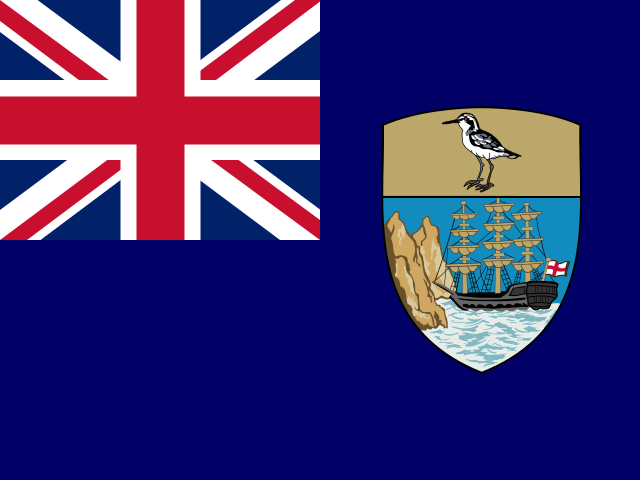
The Saint Helena flag consists of a blue field with the Union Jack in the upper hoist canton and the Saint Helena shield in the fly half. The shield features a rocky coastline with a three-masted ship sailing toward the island, and above it a Saint Helena plover — known locally as the wirebird — the island's national bird. The proportion is 1:2. It was adopted on 4 October 1984, when Saint Helena was granted its own flag as a British Dependent Territory.
Colors and meaning
The blue field and Union Jack represent Saint Helena's status as a British Overseas Territory and its connection to the United Kingdom, the blue also representing the South Atlantic Ocean that surrounds the island. The shield represents the island's history and wildlife — the ship recalls the island's role as a vital port on the route to India, and the wirebird is the island's national bird.
Union Jack
Represents Saint Helena's constitutional status as a British Overseas Territory and its historical ties to the United Kingdom. The Union Jack appears in the upper hoist canton of the flag, following the standard pattern for British colonial and overseas territory flags.
Blue field
Represents the South Atlantic Ocean that surrounds Saint Helena — one of the most remote inhabited islands in the world, located about 1,900 kilometers west of the coast of Angola and Namibia.
Ship
The three-masted ship on the shield represents the East Indiaman 'Windsor Castle' arriving at the island, recalling Saint Helena's history as a vital port of call for ships traveling between Europe and Asia. The island was administered by the British East India Company from 1659 to 1834, and Napoleon Bonaparte was exiled there from 1815 until his death in 1821.
Wirebird
The Saint Helena plover, known locally as the wirebird, is the national bird of Saint Helena and appears at the top of the shield. It is endemic to the island and is one of the world's rarest birds — only a few hundred individuals remain. The wirebird is named for its thin, wire-like legs and is a symbol of the island's unique natural heritage.
History and adoption
Saint Helena has been a British territory since 1659, when the British East India Company took possession of the island. It was administered by the East India Company until 1834, when it became a Crown colony, and it served as the place of exile for Napoleon Bonaparte from 1815 until his death in 1821. Saint Helena's flag was adopted on 4 October 1984, when it was granted a Blue Ensign with the island's own coat of arms in the fly. The flag was retained when Saint Helena, Ascension and Tristan da Cunha were reorganized as a single territory with a new constitution in 2009. It remains the official flag of Saint Helena island, alongside the separate flags of Ascension Island and Tristan da Cunha.
Key facts
- Adopted
- 4 October 1984
- Proportion
- 1:2
- Designer
- Based on the Saint Helena coat of arms granted in 1984
- Capital
- Jamestown
- Country code
- SH-HL
- Similar flags
- Other British Overseas Territories
Historical and related flags
Saint Helena has used several flags across its history, and separate flags now exist for Ascension Island and Tristan da Cunha.
- British East India Company (1659–1834): Company flag used during the East India Company's administration.
- British Crown colony (1834–1984): British Union Jack and colonial flags used.
- Current flag (1984–present): Blue Ensign with the Saint Helena shield.
- Ascension Island flag (2013–present): Separate Blue Ensign with its own shield.
- Tristan da Cunha flag (2002–present): Separate Blue Ensign with its own shield.
- Governor's flag: A Union Jack defaced with the Saint Helena coat of arms in the center.
Frequently asked questions
What does the flag of Saint Helena look like?
The flag of Saint Helena is a British Blue Ensign — a blue field with the Union Jack in the upper hoist canton and the Saint Helena shield in the fly. The proportion is 1:2.
When was the flag of Saint Helena adopted?
The current flag of Saint Helena was officially adopted on 4 October 1984.
What do the colors mean?
The blue field and Union Jack represent Saint Helena's status as a British Overseas Territory and its connection to the United Kingdom, the blue also representing the South Atlantic Ocean that surrounds the island. The shield represents the island's history and wildlife — the ship recalls the island's role as a vital port on the route to India, and the wirebird is the island's national bird.
Which flags look similar to the Saint Helena flag?
Saint Helena's flag follows the standard pattern for British Overseas Territories — a Blue Ensign with the Union Jack in the canton and a distinctive shield in the fly. It is similar in structure to the flags of the Falkland Islands, Montserrat, the British Virgin Islands and the Cayman Islands, but its shield with the ship and wirebird is unique.

 United Kingdom
 Saint Helena, Ascension and Tristan da Cunha
 Falkland Islands
 Montserrat
 British Virgin Islands
 South Africa