What the flag looks like
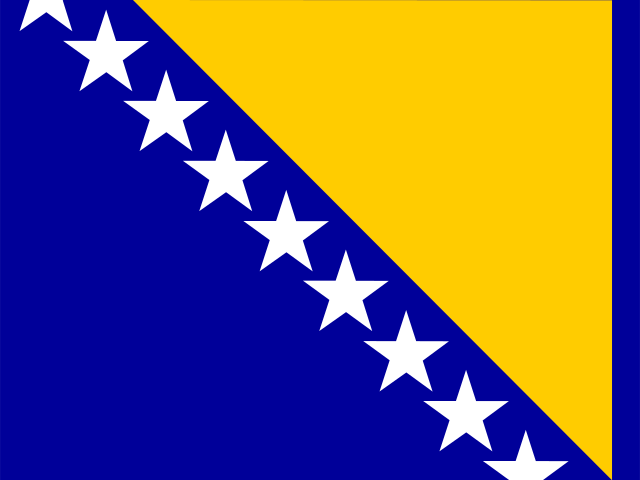
The flag of Bosnia and Herzegovina consists of a blue field with a yellow isosceles triangle that occupies the upper hoist and lower fly areas. A diagonal line of seven white five-pointed stars runs parallel to the triangle's hypotenuse — the stars are equally spaced, and the top and bottom stars are cut in half by the edges of the flag. The proportion is 1:2. It was adopted on 4 February 1998, replacing the earlier flag used since independence in 1992.
Colors and meaning
The blue field with white stars represents Europe and the European Union, and is drawn from the flag of the European Union. The yellow triangle represents the three constituent peoples of Bosnia and Herzegovina — Bosniaks, Croats and Serbs — and the shape of the country. The stars represent the country's aspiration to join the European Union.
Blue field
Represents Europe and the European Union, and is drawn from the flag of the European Union. Blue also represents peace and stability — a central hope for post-war Bosnia and Herzegovina.
Yellow triangle
Represents the three constituent peoples of Bosnia and Herzegovina — Bosniaks, Croats and Serbs — and the approximate shape of the country. The triangle also symbolizes the country's balance between its three main ethnic groups.
White stars
Represent the country's aspiration to join the European Union — an aspiration shared by all three constituent peoples. The seven stars along the hypotenuse are white, and the top and bottom stars are cut in half by the flag's edges, symbolizing the country's ongoing path toward European integration. The seven stars also represent the seven countries that border Bosnia and Herzegovina — Croatia, Serbia and Montenegro (land borders) and Italy, Slovenia, Hungary and Romania (via the Adriatic Sea, which Bosnia and Herzegovina touches at Neum).
Design origin
The flag was designed by Carlos Westendorp, the High Representative of the international community in Bosnia and Herzegovina, after the Bosnian parliament failed to agree on a design. It was adopted on 4 February 1998 and deliberately avoids any reference to the country's three main ethnic groups or historic symbols, to prevent one group from feeling excluded.
History and adoption
Bosnia and Herzegovina declared independence from Yugoslavia on 1 March 1992, following a referendum boycotted by most Bosnian Serbs. The first flag was a white field with a blue shield bearing the golden fleur-de-lis of the medieval Bosnian kingdom. This flag was used by the Republic of Bosnia and Herzegovina during the Bosnian War (1992–1995), but was not accepted by the country's Serb and Croat communities. After the Dayton Agreement ended the war in 1995, the new state needed a flag that would be acceptable to all three communities. The Bosnian parliament failed to agree on a design, so the High Representative, Carlos Westendorp, imposed the current flag on 4 February 1998. It has remained unchanged since.
Key facts
- Adopted
- 4 February 1998
- Proportion
- 1:2
- Designer
- Carlos Westendorp, High Representative of Bosnia and Herzegovina
- Capital
- Sarajevo
- Country code
- BA
- Similar flags
- None
Historical and related flags
Bosnia and Herzegovina has used several flags across its medieval, Yugoslav and post-independence periods.
- Kingdom of Bosnia (1377–1463): Various banners with the Bosnian coat of arms.
- Ottoman Bosnia (1463–1878): Ottoman flags used during Ottoman rule.
- Austro-Hungarian Bosnia (1878–1918): Austro-Hungarian flags used.
- Yugoslav Bosnia (1918–1941): Yugoslav flag used.
- SR Bosnia and Herzegovina (1945–1992): Yugoslav flag with a red star and Bosnian emblem.
- Republic of Bosnia and Herzegovina (1992–1998): White field with blue shield and golden fleur-de-lis.
- Current flag (1998–present): Blue field with yellow triangle and diagonal line of white stars.
- Entities: Federation of Bosnia and Herzegovina and Republika Srpska have their own flags.
Frequently asked questions
What does the flag of Bosnia and Herzegovina look like?
The flag of Bosnia and Herzegovina is a blue field with a yellow isosceles triangle based on the hoist and fly sides. A diagonal line of seven white five-pointed stars runs along the triangle's hypotenuse. The proportion is 1:2.
When was the flag of Bosnia and Herzegovina adopted?
The current flag of Bosnia and Herzegovina was officially adopted on 4 February 1998.
What do the colors mean?
The blue field with white stars represents Europe and the European Union, and is drawn from the flag of the European Union. The yellow triangle represents the three constituent peoples of Bosnia and Herzegovina — Bosniaks, Croats and Serbs — and the shape of the country. The stars represent the country's aspiration to join the European Union.
Which flags look similar to the Bosnia and Herzegovina flag?
No other national flag closely resembles Bosnia and Herzegovina's. The combination of a blue field with a yellow triangle and a diagonal line of white stars is unique, though the blue field with white stars is drawn from the European Union flag.

 Serbia
 Croatia
 Montenegro
 Slovenia
 Kosovo
 North Macedonia