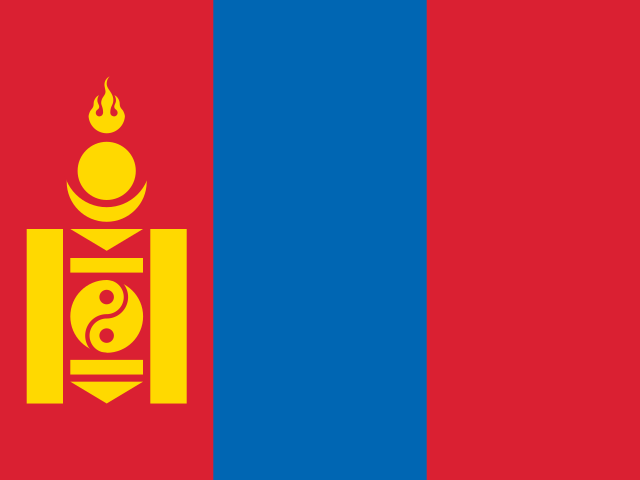
What the flag looks like
The Mongolian flag consists of three equal vertical bands of red (hoist), blue (center) and red (fly). In the left red band is the golden Soyombo symbol — a traditional Mongolian emblem consisting of a flame, sun, moon, arrows, rectangles and the yin-yang symbol. The proportion is 1:2. The design was adopted on 12 February 1992, following the democratic revolution and the end of the Mongolian People's Republic.
Colors and meaning
Red represents the Mongolian people's progress, prosperity and the eternal blue sky, blue represents the eternal blue sky of the Mongol homeland and the vast steppes, and the golden Soyombo symbol represents the independence, sovereignty and spirit of the Mongolian nation.
Red
Represents progress, prosperity and the strength of the Mongolian people. Red is a traditional color of celebration and good fortune in Mongolian culture, and it also appears on the historical banners of Genghis Khan and the Mongol Empire.
Blue
Represents the 'Munkh Khukh Tenger' — the eternal blue sky — which is the central spiritual concept of Mongolian traditional belief. Blue also represents the vast open steppes that define Mongolia's landscape.
Soyombo symbol
The golden Soyombo symbol is the national emblem of Mongolia and appears on the flag's hoist side. It consists of several elements, each with its own meaning: the flame at the top represents eternal growth and the revival of the nation; the sun and moon represent the eternal existence of the Mongol nation; the arrows represent the defense of the nation; the rectangles represent honesty and justice; the yin-yang symbol at the base represents the balance of male and female principles.
History and adoption
Mongolia declared independence from China in 1911, following the collapse of the Qing dynasty, and became a Soviet-aligned socialist state in 1924 as the Mongolian People's Republic. The first Mongolian flag was a red flag with the Soyombo symbol in the center and the Mongolian script on the side. In 1940, the flag was changed to a red field with the Soyombo symbol in the center, and later variations included a blue band added to the design. After the democratic revolution of 1990, the communist star was removed from the flag, and on 12 February 1992, the current design was adopted — red, blue and red vertical bands with the Soyombo symbol in the left red band. It has remained unchanged since.
Key facts
- Adopted
- 12 February 1992
- Proportion
- 1:2
- Designer
- Based on the traditional Soyombo symbol
- Capital
- Ulaanbaatar
- Country code
- MN
- Similar flags
- None
Historical and related flags
Mongolia has used several flags across its imperial, socialist and democratic periods.
- Mongol Empire (1206–1368): Various banners including the Sulde, a horsetail banner.
- Bogd Khanate (1911–1921): Yellow flag with the Soyombo symbol and Buddhist elements.
- Mongolian People's Republic (1924–1940): Red flag with Soyombo and Mongolian script.
- Mongolian People's Republic (1940–1992): Red field with the Soyombo and later a blue band.
- Current flag (1992–present): Red, blue and red vertical bands with the Soyombo symbol.
- Presidential standard: Uses the Mongolian coat of arms with a horse, a flying horse and other symbols.
Frequently asked questions
What does the flag of Mongolia look like?
The flag of Mongolia has three equal vertical bands of red (hoist), blue (center) and red (fly), with the golden Soyombo symbol in the left red band. The proportion is 1:2.
When was the flag of Mongolia adopted?
The current flag of Mongolia was officially adopted on 12 February 1992.
What do the colors mean?
Red represents the Mongolian people's progress, prosperity and the eternal blue sky, blue represents the eternal blue sky of the Mongol homeland and the vast steppes, and the golden Soyombo symbol represents the independence, sovereignty and spirit of the Mongolian nation.
Which flags look similar to the Mongolia flag?
No other national flag closely resembles Mongolia's. The combination of red, blue and red vertical bands with the Soyombo symbol is unique.

 China
 Russia
 Kazakhstan
 Kyrgyzstan
 North Korea
 Bhutan