What the flag looks like
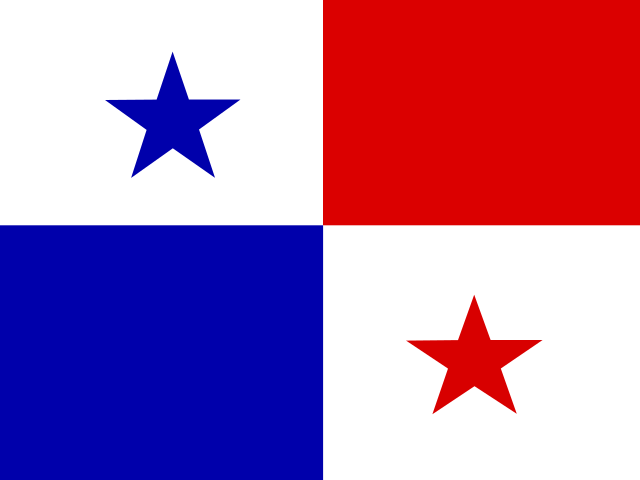
The Panamanian flag is divided into four rectangular quarters. The top-left quarter is white with a blue five-pointed star, the top-right is red, the bottom-left is blue, and the bottom-right is white with a red five-pointed star. The proportion is 2:3. It was designed by Manuel Amador Guerrero and formally adopted on 4 November 1925, after Panama gained independence from Colombia in 1903.
Colors and meaning
Blue and red represent Panama's two main political parties at the time of independence — the Conservatives (blue) and the Liberals (red) — and their union in the new republic. White represents peace, and the two stars represent the two parties working together for the nation's future.
White
Represents peace and the peaceful transition of Panama to independence.
Red
Represents the Liberal Party, one of the two main political parties in early 20th-century Panama. Red also represents courage and the blood shed for independence.
Blue
Represents the Conservative Party, the other main political party. Blue also represents the Pacific Ocean and Caribbean Sea that border Panama.
Two stars
The blue and red stars represent the two political parties, working together in a spirit of cooperation for the good of the nation. Placing them in the opposite-colored quadrants emphasizes the balance between them.
History and adoption
Panama declared independence from Colombia on 3 November 1903, with support from the United States. The flag was designed by Manuel Amador Guerrero, the country's first president, and was first raised on 4 November 1903. However, it was not formally adopted until 4 November 1925, when the design was standardized by law. The original design had the same four-quarter layout but with slightly different proportions. Since 1925, the flag has remained unchanged, and it is celebrated every 4 November as Panamanian Flag Day.
Key facts
- Adopted
- 4 November 1925
- Proportion
- 2:3
- Designer
- Manuel Amador Guerrero (design), María Ossa de Amador (sewing)
- Capital
- Panama City
- Country code
- PA
- Similar flags
- None
Historical and related flags
Panama used several flags before and after its independence in 1903.
- Spanish colonial (pre-1821): Spanish flag used during colonial rule.
- Gran Colombia (1821–1831): Yellow-blue-red tricolor used as part of Gran Colombia.
- Colombia (1831–1903): Colombian flag used as part of Colombia.
- First Panamanian flag (1903): Original design by Manuel Amador Guerrero.
- Current flag (1925–present): Standardized design formally adopted.
- Presidential standard: Uses the Panamanian coat of arms.
Frequently asked questions
What does the flag of Panama look like?
The flag of Panama is divided into four quarters: white with a blue star (top left), red (top right), blue (bottom left), and white with a red star (bottom right). The proportion is 2:3.
When was the flag of Panama adopted?
The current flag of Panama was officially adopted on 4 November 1925.
What do the colors mean?
Blue and red represent Panama's two main political parties at the time of independence — the Conservatives (blue) and the Liberals (red) — and their union in the new republic. White represents peace, and the two stars represent the two parties working together for the nation's future.
Which flags look similar to the Panama flag?
No other national flag closely resembles Panama's. The four-quarter layout with two stars in opposite-colored quarters is unique among national flags.

 Colombia
 Costa Rica
 Nicaragua
 Venezuela
 Ecuador
 Honduras