What the flag looks like
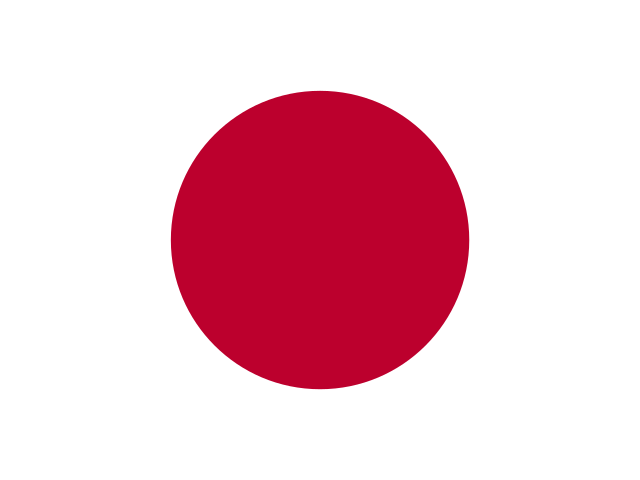
The Japanese flag is a white field with a crimson disc at its center, representing the sun. The diameter of the disc is three-fifths of the flag's height, and the flag proportion is 2:3. The design has been used unofficially since the 19th century and was formalized as the national flag by the Act on National Flag and Anthem in 1999.
Colors and meaning
White represents purity and honesty, and the crimson disc represents the sun, reflecting Japan's name — 'Land of the Rising Sun'. The design has deep cultural roots and was historically used on banners by samurai and during the Meiji period.
White
Represents purity, honesty and integrity — a value central to Japanese aesthetics and Shinto tradition.
Crimson
Represents sincerity, warmth and the sun itself. The specific shade used today is a bright, slightly pinkish red specified by the 1999 law.
Hinomaru (sun disc)
The red circle represents the rising sun, an ancient symbol of Japan and its imperial lineage. The name 'Japan' in Chinese characters (日本) literally means 'origin of the sun'.
Proportions
The 1999 law set the disc diameter to three-fifths of the flag's height, larger than many pre-modern versions of the Hinomaru.
History and adoption
The Hinomaru has been used in Japan since at least the 7th century, when it appeared on banners and court decorations. During the Edo period it was used on merchant ships, and in 1870 the Meiji government designated it for use on Japanese vessels. It served as the de facto national flag throughout the imperial era, but was only formally codified as the national flag on 13 August 1999 with the Act on National Flag and Anthem. The 1999 law also fixed the disc's proportions and the exact shade of red.
Key facts
- Adopted
- 13 August 1999 (de facto since 1870)
- Proportion
- 2:3
- Designer
- Unknown — traditional design formalized by the Meiji government
- Capital
- Tokyo
- Country code
- JP
- Similar flags
- Bangladesh, Palau
Historical and related flags
The Rising Sun flag (Kyokujitsu-ki) — a sun with rays — is a distinct symbol used by the Japanese military since 1870 and remains in use by the Japan Self-Defense Forces. It is not the national flag and is not interchangeable with the Hinomaru.
- Rising Sun Flag (1870–1945): Used by the Imperial Japanese Army and Navy, with 16 rays.
- Japan Self-Defense Forces flag (1954–present): A modern version with adjusted proportions.
- Meiji-era merchant flag: A smaller-disc Hinomaru used on civilian vessels before 1999.
Frequently asked questions
What does the flag of Japan look like?
The flag of Japan is a white rectangle with a large crimson circle in the center, representing the sun. It is known as the Hinomaru, meaning 'circle of the sun'.
When was the flag of Japan adopted?
The current flag of Japan was officially adopted on 13 August 1999 (de facto since 1870).
What do the colors mean?
White represents purity and honesty, and the crimson disc represents the sun, reflecting Japan's name — 'Land of the Rising Sun'. The design has deep cultural roots and was historically used on banners by samurai and during the Meiji period.
Which flags look similar to the Japan flag?
Bangladesh also uses a red disc, but on a green field and offset toward the hoist. Palau uses a yellow disc on a light blue field. Japan's white-and-red design is otherwise unique.

 South Korea
 China
 Vietnam
 Philippines
 Bangladesh
 Palau