What the flag looks like
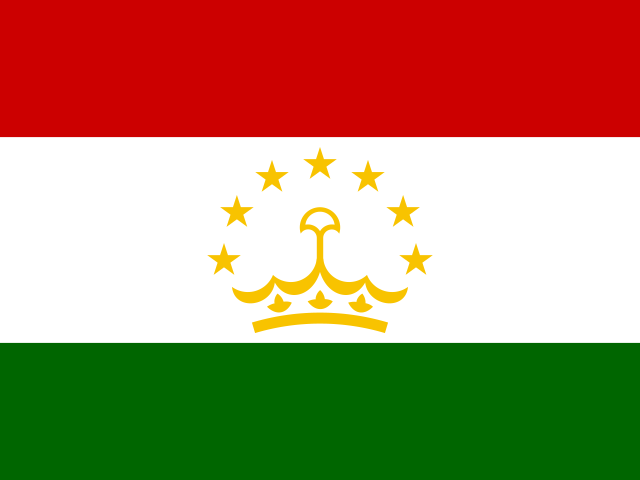
The Tajik flag consists of three horizontal bands of red (top), white (center) and green (bottom), with a golden crown surmounted by an arc of seven golden five-pointed stars in the center of the white band. The proportion is 1:2. It was adopted on 24 November 1992, following Tajikistan's independence from the Soviet Union in 1991.
Colors and meaning
Red represents the unity of the nation and the blood shed for Tajik independence, white represents purity, cotton and the snow of the Tajik mountains, and green represents the fertile valleys and the country's agricultural wealth. The golden crown and seven stars represent Tajik sovereignty and the country's seven historical regions.
Red band
Represents the unity of the Tajik nation and the blood shed by Tajik patriots in the struggle for independence and statehood. Red was also the color of the Tajik Soviet Socialist Republic's flag, and its retention reflects continuity with the Soviet era.
White band
Represents purity, cotton (one of Tajikistan's main agricultural products) and the snow that covers the peaks of the Pamir Mountains, which dominate the country's landscape. White is also a color of peace and hope.
Green band
Represents the fertile valleys and agricultural wealth of Tajikistan, and Islam — the dominant religion of the country. Green is a traditional Islamic color and appears on many Muslim national flags.
Golden crown and seven stars
The golden crown (toj) is a symbol of Tajik sovereignty — the Tajik word 'tojik' means 'crowned'. The seven stars above the crown represent the seven historical regions of Tajikistan and the seven virtues of the Tajik people in Zoroastrian tradition. The crown and stars together are also a reference to the Samanid Empire, a medieval Tajik state that is considered the foundation of Tajik national identity.
Design origin
The flag was designed after Tajikistan gained independence from the Soviet Union on 9 September 1991. The design was adopted on 24 November 1992 and has remained unchanged since. It combines the Pan-Iranian colors of red, white and green (shared with Iran and Tajikistan's Persian cultural heritage) with Soviet-era red and Islamic green.
History and adoption
Tajikistan was part of the Russian Empire from the late 19th century, then became the Tajik Autonomous Soviet Socialist Republic in 1924 and a full Soviet republic in 1929. The Tajik SSR used a red flag with a white and green stripe and Soviet symbols (hammer, sickle, star and cotton). Tajikistan declared independence on 9 September 1991, following the collapse of the Soviet Union. The current flag was adopted on 24 November 1992, replacing the Soviet-era flag. The design drew on the colors of the Tajik SSR (red, white and green) and added the crown and stars as a symbol of Tajik sovereignty. The flag has remained unchanged since.
Key facts
- Adopted
- 24 November 1992
- Proportion
- 1:2
- Designer
- Zuhur Habibullaev and others
- Capital
- Dushanbe
- Country code
- TJ
- Similar flags
- Iran, Hungary
Historical and related flags
Tajikistan has used several flags across its Soviet and post-Soviet periods.
- Tajik ASSR (1924–1929): Red flag with Soviet symbols and Cyrillic initials.
- Tajik SSR (1929–1937): Red flag with hammer and sickle and Cyrillic initials.
- Tajik SSR (1937–1953): Red flag with Cyrillic inscription.
- Tajik SSR (1953–1991): Red flag with white and green stripes and Soviet symbols.
- Current flag (1992–present): Red, white and green bands with crown and seven stars.
- Presidential standard: Uses the Tajik coat of arms with a crown, stars, mountains and a book.
Frequently asked questions
What does the flag of Tajikistan look like?
The flag of Tajikistan has three horizontal bands of red (top), white (center, wider) and green (bottom), with a golden crown surmounted by seven golden five-pointed stars in the center of the white band. The proportion is 1:2.
When was the flag of Tajikistan adopted?
The current flag of Tajikistan was officially adopted on 24 November 1992.
What do the colors mean?
Red represents the unity of the nation and the blood shed for Tajik independence, white represents purity, cotton and the snow of the Tajik mountains, and green represents the fertile valleys and the country's agricultural wealth. The golden crown and seven stars represent Tajik sovereignty and the country's seven historical regions.
Which flags look similar to the Tajikistan flag?
Iran uses green, white and red horizontal bands with a central emblem, in reverse order. Hungary uses red, white and green horizontal bands without an emblem. Tajikistan's red-white-green with a central golden crown and seven stars is unique.

 Afghanistan
 Uzbekistan
 Kyrgyzstan
 Turkmenistan
 Iran
 China