What the flag looks like
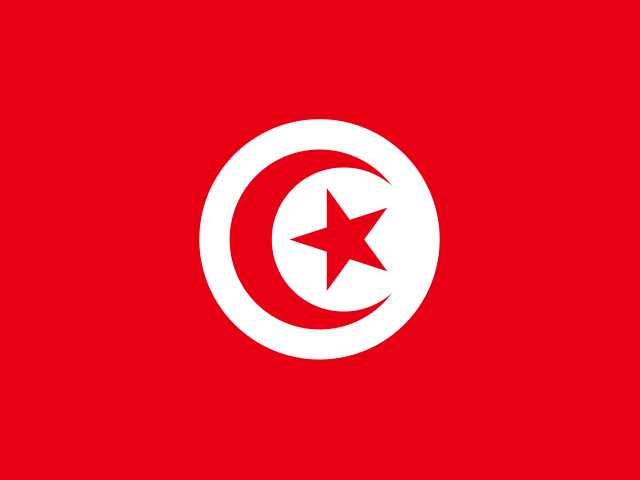
The Tunisian flag consists of a red field with a large white circle in the center. Inside the circle are a red crescent moon and a red five-pointed star, both pointing toward the fly side. The proportion is 2:3. It was adopted on 20 March 1956, when Tunisia gained independence from France, and confirmed by the 1959 constitution.
Colors and meaning
Red represents the blood shed by Tunisian patriots in the struggle for independence and the courage of the Tunisian people, and white represents peace and purity. The crescent and star are traditional symbols of Islam and are shared with other Muslim nations. The combined red crescent and star within a white disc represent the Tunisian nation and its Islamic faith.
Red
Represents the blood shed by Tunisian patriots in the struggle for independence from France, achieved in 1956, and the courage and resilience of the Tunisian people throughout their long history.
White
Represents peace, purity and hope. The white disc provides a neutral background for the red crescent and star.
Crescent
Represents Islam, the dominant religion of Tunisia, and its presence in the country since the 7th century. The crescent is one of the oldest Islamic symbols.
Five-pointed star
Represents the five pillars of Islam and, in some interpretations, the light of guidance. The star sits inside the opening of the crescent, both pointing toward the fly.
Historical origin
The design derives from the flag of the Ottoman Empire and the beylical flag of Tunisia, which featured a crescent and star on a red field since the 18th century.
History and adoption
Tunisia was part of the Ottoman Empire from the 16th century until 1881, when it became a French protectorate. During the Ottoman period, Tunisian beys used a red flag with a crescent and star. In the 19th century, a white disc was added to the design, giving the flag its modern appearance. On 20 March 1956, Tunisia gained independence from France, and the flag was formally adopted. The 1959 constitution confirmed the design, which has remained unchanged since — including after the abolition of the monarchy in 1957 and the establishment of the republic.
Key facts
- Adopted
- 20 March 1956
- Proportion
- 2:3
- Designer
- Traditional — derived from the Ottoman-era beylical flag
- Capital
- Tunis
- Country code
- TN
- Similar flags
- Turkey, Algeria, Pakistan
Historical and related flags
Tunisia has used several flags across its Ottoman, French colonial and independence periods.
- Ottoman Tunisia (1574–1705): Ottoman flags used, sometimes with local variations.
- Beylikal Tunisia (1705–1881): Red flag with crescent and star.
- French protectorate (1881–1956): French flag used for official purposes; beylical flag retained.
- Current flag (1956–present): Red field with white disc bearing a red crescent and star.
- Presidential standard: Uses the Tunisian coat of arms with a golden crescent and star.
Frequently asked questions
What does the flag of Tunisia look like?
The flag of Tunisia is a red field with a white circle in the center containing a red crescent moon and a red five-pointed star. The proportion is 2:3.
When was the flag of Tunisia adopted?
The current flag of Tunisia was officially adopted on 20 March 1956.
What do the colors mean?
Red represents the blood shed by Tunisian patriots in the struggle for independence and the courage of the Tunisian people, and white represents peace and purity. The crescent and star are traditional symbols of Islam and are shared with other Muslim nations. The combined red crescent and star within a white disc represent the Tunisian nation and its Islamic faith.
Which flags look similar to the Tunisia flag?
Turkey uses a red field with a white crescent and star. Algeria uses green and white bands with a red crescent and star. Pakistan uses a green field with a white crescent and star. Tunisia's red crescent and star on a white disc on a red field is unique.

 Algeria
 Libya
 Morocco
 Egypt
 Turkey
 Pakistan