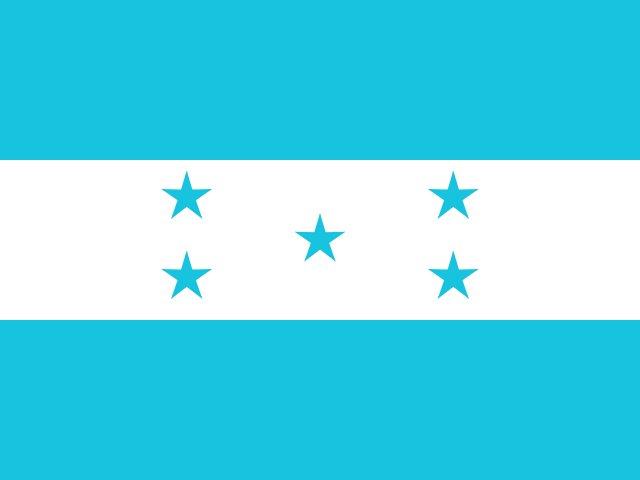
What the flag looks like
The Honduran flag consists of three equal horizontal bands of blue (top), white (middle) and blue (bottom), with five blue five-pointed stars arranged in an X (quincunx) pattern in the center of the white band. The proportion is 1:2. It was adopted on 16 February 1866, and the five stars were added in 1866 as well, though their placement was standardized in 2022 when the flag was updated to use a lighter shade of blue.
Colors and meaning
Blue represents the Pacific Ocean and the Caribbean Sea that border Honduras, and the sky and brotherhood, and white represents peace, purity and the land between the two oceans. The five blue stars represent the five nations of the former United Provinces of Central America, with the hope that they might one day reunite.
Blue
Represents the two oceans that border Honduras — the Pacific Ocean to the south and the Caribbean Sea to the north — and the sky, brotherhood and the ideals of the Central American union.
White
Represents peace, purity and the land between the two oceans. White also represents the desire for peace and prosperity.
Five stars
Represent the five nations of the former United Provinces of Central America: Guatemala, El Salvador, Honduras, Nicaragua and Costa Rica. The X pattern (quincunx) is a traditional arrangement symbolizing unity and the hope for Central American reunification.
Color shade
In 2022, Honduras officially changed the shade of blue on its flag from the darker navy blue used since 1949 to a lighter turquoise blue, matching the blue used during the Central American federation.
History and adoption
Honduras declared independence from Spain in 1821 and joined the United Provinces of Central America in 1823, adopting the blue-white-blue tricolor of the federation. When the federation dissolved in 1838, Honduras retained the tricolor. The flag was formally adopted on 16 February 1866 under President José María Medina, and the five blue stars were added in the same year to represent the five nations of the former federation. In 1949, the shade of blue was changed to a darker navy, and in 2022 it was changed back to a lighter turquoise blue. The design and layout have otherwise remained unchanged since 1866.
Key facts
- Adopted
- 16 February 1866
- Proportion
- 1:2
- Designer
- Based on the flag of the United Provinces of Central America
- Capital
- Tegucigalpa
- Country code
- HN
- Similar flags
- Nicaragua, El Salvador, Guatemala
Historical and related flags
Honduras has used several flags across its colonial, federal and independent periods.
- Spanish colonial (pre-1821): Spanish flag used during colonial rule.
- United Provinces of Central America (1823–1838): Blue-white-blue tricolor of the federation.
- Independent Honduras (1838–1866): Plain blue-white-blue tricolor.
- Current design (1866–present): Blue-white-blue with five blue stars in the center.
- Color change (1949): Darker navy blue adopted.
- Color change (2022): Lighter turquoise blue restored.
Frequently asked questions
What does the flag of Honduras look like?
The flag of Honduras has three equal horizontal bands of blue (top), white (middle) and blue (bottom), with five blue five-pointed stars arranged in an X pattern in the center of the white band. The proportion is 1:2.
When was the flag of Honduras adopted?
The current flag of Honduras was officially adopted on 16 February 1866.
What do the colors mean?
Blue represents the Pacific Ocean and the Caribbean Sea that border Honduras, and the sky and brotherhood, and white represents peace, purity and the land between the two oceans. The five blue stars represent the five nations of the former United Provinces of Central America, with the hope that they might one day reunite.
Which flags look similar to the Honduras flag?
Nicaragua and El Salvador use blue-white-blue tricolors with their own coats of arms in the center. Guatemala uses vertical blue-white-blue bands. Honduras is the only one of the group with five stars in the center of the white band.

 Nicaragua
 El Salvador
 Guatemala
 Costa Rica
 Panama
 Belize