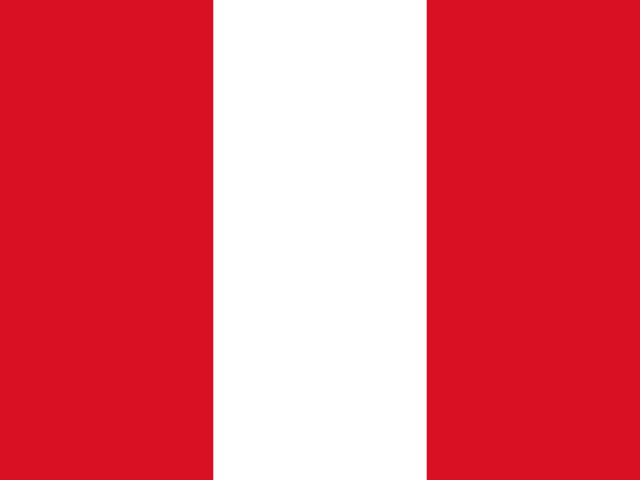
What the flag looks like
The Peruvian flag consists of three equal vertical bands of red (hoist), white (center) and red (fly). The national flag (bandera nacional) is the plain version, while the state flag (pabellón nacional) adds the Peruvian coat of arms in the center of the white band. The proportion is 2:3. It was adopted on 25 February 1825, during the Peruvian War of Independence.
Colors and meaning
Red represents the blood shed by Peruvian patriots in the struggle for independence, and white represents peace and the purity of the Peruvian people. According to legend, the colors were inspired by the red-and-white plumage of the parihuanas, a species of flamingo that General José de San Martín saw when he landed in Peru in 1820.
Red
Represents the blood shed by Peruvian patriots during the long struggle for independence from Spain, achieved in 1824 at the Battle of Ayacucho.
White
Represents peace, purity and the noble ideals of the Peruvian people.
Legend of the parihuanas
According to tradition, General José de San Martín landed at Paracas in 1820 and saw flocks of parihuanas — Andean flamingos with red and white plumage — rising into the air. He chose those colors for the new flag of independent Peru.
Coat of arms
The state flag includes the Peruvian coat of arms, which features a vicuña (national animal), a cinchona tree (source of quinine) and a cornucopia spilling golden coins, representing Peru's natural wealth.
History and adoption
Peru declared independence from Spain on 28 July 1821, and General José de San Martín designed the first Peruvian flag — a version with four diagonal sections in red and white. This design was difficult to produce and was replaced in 1822 by a red-white-red horizontal design. In 1825, Simón Bolívar standardized the flag as a vertical red-white-red tricolor, which remains in use today. The coat of arms has been modified several times, but the plain tricolor has been unchanged since 1825, making it one of the oldest national flags in South America.
Key facts
- Adopted
- 25 February 1825
- Proportion
- 2:3
- Designer
- José de San Martín (initial design), Simón Bolívar (final design)
- Capital
- Lima
- Country code
- PE
- Similar flags
- Canada, Austria
Historical and related flags
Peru has used several flags across its colonial, independence and republican periods, and today uses three official variants.
- First flag (1820–1822): Diagonal red and white sections, designed by San Martín.
- Second flag (1822–1825): Red-white-red horizontal bands.
- Current design (1825–present): Vertical red-white-red tricolor.
- National flag (bandera nacional): Plain tricolor used by citizens.
- State flag (pabellón nacional): Tricolor with the coat of arms, used by the government.
- War flag (bandera de guerra): Tricolor with the national shield, used by the military.
Frequently asked questions
What does the flag of Peru look like?
The flag of Peru has three equal vertical bands of red (hoist), white (center) and red (fly). The state flag adds the Peruvian coat of arms in the center of the white band. The proportion is 2:3.
When was the flag of Peru adopted?
The current flag of Peru was officially adopted on 25 February 1825.
What do the colors mean?
Red represents the blood shed by Peruvian patriots in the struggle for independence, and white represents peace and the purity of the Peruvian people. According to legend, the colors were inspired by the red-and-white plumage of the parihuanas, a species of flamingo that General José de San Martín saw when he landed in Peru in 1820.
Which flags look similar to the Peru flag?
Canada uses a red-white-red vertical design with a maple leaf. Austria uses horizontal red-white-red bands. Peru's plain vertical red-white-red is unique among national flags, though the state version with the coat of arms is similar in structure to Canada's flag.

 Chile
 Ecuador
 Bolivia
 Colombia
 Argentina
 Canada