What the flag looks like
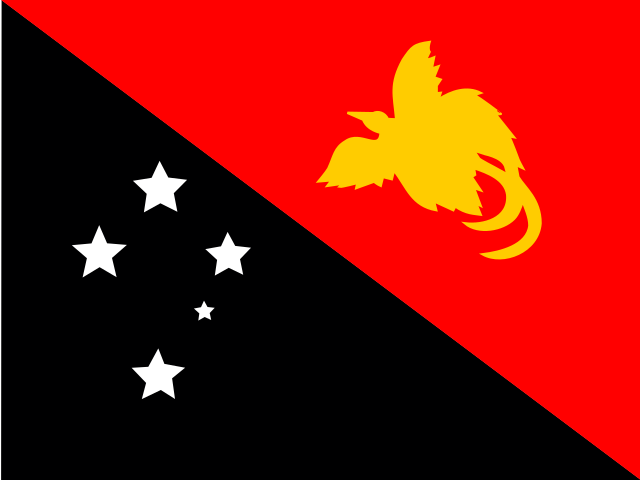
The Papua New Guinean flag is divided diagonally from the upper hoist corner to the lower fly corner. The upper right half is red and features a yellow bird-of-paradise (the national bird), and the lower left half is black with five white five-pointed stars representing the Southern Cross constellation. The proportion is 3:4. It was adopted on 1 July 1971, four years before Papua New Guinea gained full independence from Australia on 16 September 1975.
Colors and meaning
Red represents the blood shed in the struggle for Papuan independence and the courage of the Papuan people, black represents the country's dark past under colonial rule and the Melanesian people, gold represents the bird-of-paradise and the country's natural wealth, and the white stars represent the Southern Cross and Papua New Guinea's location in the Southern Hemisphere.
Red half
Represents the blood shed by Papuan patriots in the long struggle for independence and the courage and determination of the Papuan people.
Black half
Represents the country's dark past under German, British and Australian colonial rule, and the Melanesian people who make up the vast majority of Papua New Guinea's population.
Bird-of-paradise
The golden bird-of-paradise is the national bird of Papua New Guinea and one of the country's most recognizable symbols. Papua New Guinea is home to over 40 species of birds-of-paradise, more than any other country in the world. The bird represents the country's unique wildlife, cultural heritage and national identity. The bird's feathers are also used in traditional Papuan ceremonial dress.
Southern Cross
The five white stars represent the Southern Cross constellation, which is visible from Papua New Guinea's location just south of the equator. The stars are Alpha, Beta, Gamma, Delta and Epsilon Crucis. The Southern Cross symbolizes the country's location in the Southern Hemisphere and its connection to other Pacific and Southern Hemisphere nations.
Design origin
The flag was designed by Susan Karike, a 15-year-old student, who won a national competition in 1971. Her design was chosen from over 100 entries and was adopted on 1 July 1971, four years before independence.
History and adoption
Papua New Guinea was divided between German New Guinea (in the north) and British New Guinea (in the south) in the late 19th century. After World War I, the German portion was administered by Australia as a League of Nations mandate, and after World War II the two territories were combined as the Territory of Papua and New Guinea under Australian administration. The flag was designed in 1971 by Susan Karike, a 15-year-old student, in a national competition held in preparation for independence. It was adopted on 1 July 1971, and was retained when Papua New Guinea gained full independence from Australia on 16 September 1975. The flag has remained unchanged since.
Key facts
- Adopted
- 1 July 1971
- Proportion
- 3:4
- Designer
- Susan Karike
- Capital
- Port Moresby
- Country code
- PG
- Similar flags
- None
Historical and related flags
Papua New Guinea used several flags during its German, British and Australian colonial periods before independence.
- German New Guinea (1884–1914): German colonial flags.
- British New Guinea (1884–1906): British Blue Ensign with a colonial badge.
- Territory of Papua (1906–1949): Australian flag used during Australian administration.
- Territory of Papua and New Guinea (1949–1971): Australian flag used during combined administration.
- Current flag (1971–present): Red and black diagonal with bird-of-paradise and Southern Cross.
- Governor-General's standard: Uses the Papua New Guinean coat of arms on a blue field.
Frequently asked questions
What does the flag of Papua New Guinea look like?
The flag of Papua New Guinea is divided diagonally from the upper hoist to the lower fly. The upper right half is red and contains a golden bird-of-paradise, and the lower left half is black and contains five white stars of the Southern Cross. The proportion is 3:4.
When was the flag of Papua New Guinea adopted?
The current flag of Papua New Guinea was officially adopted on 1 July 1971.
What do the colors mean?
Red represents the blood shed in the struggle for Papuan independence and the courage of the Papuan people, black represents the country's dark past under colonial rule and the Melanesian people, gold represents the bird-of-paradise and the country's natural wealth, and the white stars represent the Southern Cross and Papua New Guinea's location in the Southern Hemisphere.
Which flags look similar to the Papua New Guinea flag?
No other national flag closely resembles Papua New Guinea's. The combination of diagonal red and black halves with a bird-of-paradise and the Southern Cross is unique.

 Australia
 Solomon Islands
 Vanuatu
 Fiji
 New Zealand
 Indonesia