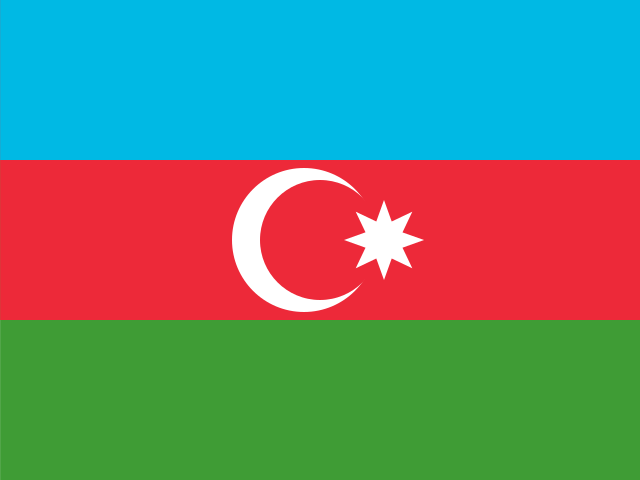
What the flag looks like
The Azerbaijani flag consists of three equal horizontal bands of blue (top), red (middle) and green (bottom), with a white crescent moon and an eight-pointed star centered on the red band. The proportion is 1:2. It was adopted on 5 February 1991, shortly before Azerbaijan declared independence from the Soviet Union, restoring a design first used by the Azerbaijan Democratic Republic in 1918.
Colors and meaning
Blue represents Azerbaijan's Turkic heritage and the sky, red represents progress, modernization and the courage of the Azerbaijani people, and green represents Islam and the country's natural environment. The white crescent represents Islam, and the eight-pointed star represents the eight branches of the Turkic peoples.
Blue
Represents Azerbaijan's Turkic heritage, the sky and the aspiration for a modern, secular state. Blue was the color of the panturkic movement in the early 20th century.
Red
Represents progress, modernization, courage and the blood shed for Azerbaijani independence.
Green
Represents Islam and the natural environment of Azerbaijan. Green is the traditional color of Islam and appears on many Muslim national flags.
Crescent
Represents Islam, the dominant religion of Azerbaijan. The crescent is one of the oldest symbols of Islamic identity.
Eight-pointed star
Represents the eight branches of the Turkic peoples, a symbol of unity among Turkic nations. The star is white, matching the crescent.
History and adoption
The Azerbaijani tricolor was first adopted by the Azerbaijan Democratic Republic on 9 December 1918, making it one of the first secular republics in the Muslim world. The design combined the Turkic blue, Islamic green and modernizing red, with a crescent and eight-pointed star. When the Red Army invaded in 1920 and Azerbaijan became part of the Soviet Union, the flag was banned and replaced with the flag of the Azerbaijan SSR. On 5 February 1991, shortly before the USSR dissolved, Azerbaijan restored the 1918 design. It has remained unchanged since independence was formally declared on 18 October 1991.
Key facts
- Adopted
- 5 February 1991
- Proportion
- 1:2
- Designer
- Ali bey Huseynzade (original 1918 design)
- Capital
- Baku
- Country code
- AZ
- Similar flags
- None
Historical and related flags
Azerbaijan has used several flags across its brief independence, Soviet and post-Soviet periods.
- Azerbaijan Democratic Republic (1918–1920): First blue-red-green tricolor with crescent and star.
- Azerbaijan SSR (1920–1921): Red flag with crescent and star.
- Azerbaijan SSR (1921–1937): Red flag with hammer and sickle and Cyrillic initials.
- Azerbaijan SSR (1937–1952): Red flag with hammer and sickle and Cyrillic inscription.
- Azerbaijan SSR (1952–1991): Red flag with a blue stripe and communist emblem.
- Current flag (1991–present): Blue-red-green tricolor with crescent and eight-pointed star restored.
Frequently asked questions
What does the flag of Azerbaijan look like?
The flag of Azerbaijan has three equal horizontal bands of blue (top), red (middle) and green (bottom), with a white crescent and an eight-pointed star in the center of the red band. The proportion is 1:2.
When was the flag of Azerbaijan adopted?
The current flag of Azerbaijan was officially adopted on 5 February 1991.
What do the colors mean?
Blue represents Azerbaijan's Turkic heritage and the sky, red represents progress, modernization and the courage of the Azerbaijani people, and green represents Islam and the country's natural environment. The white crescent represents Islam, and the eight-pointed star represents the eight branches of the Turkic peoples.
Which flags look similar to the Azerbaijan flag?
No other national flag uses this exact combination of blue, red and green bands with a crescent and eight-pointed star. It is sometimes confused with other Turkic flags, but the specific color arrangement and star shape are unique.

 Turkey
 Georgia
 Armenia
 Iran
 Kazakhstan
 Turkmenistan